
Introduction
Choosing between Grade A and Grade B office space can significantly affect your business costs, employee productivity and corporate image. In Lagos, premium offices in Victoria Island and Ikoyi often offer more advanced facilities, while Grade B offices in areas such as Ikeja and Yaba may provide practical alternatives at lower rental costs. This guide explains the differences and helps tenants and investors make informed decisions.
1. What Is Grade A Office Space?
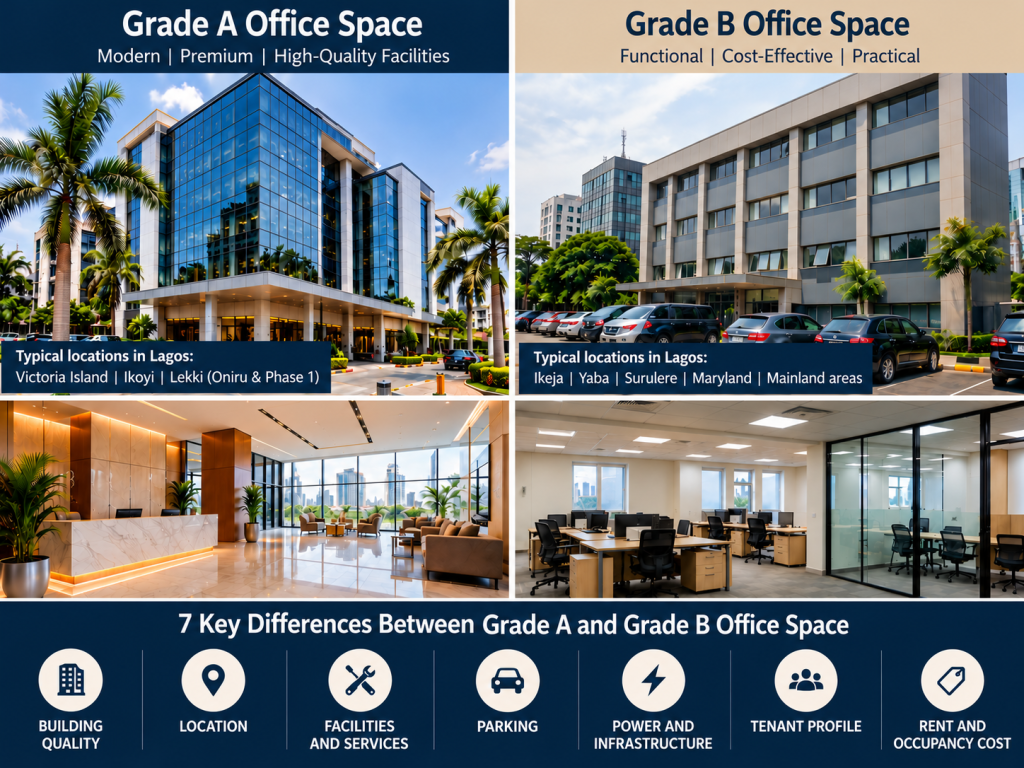
Grade A office space generally refers to high-quality commercial premises that meet demanding standards for building design, infrastructure, facilities, management and occupier experience.
These offices are commonly found in modern commercial buildings in areas such as Victoria Island, Ikoyi, Oniru and parts of Lekki Phase 1.
Typical features include:
- Modern architecture and high-quality finishes.
- Efficient lifts and professionally maintained common areas.
- Central air conditioning or other well-designed climate-control systems.
- Reliable power infrastructure and backup systems.
- Professional security, access control and building management.
- Adequate parking and well-maintained facilities.
- Strong internet and telecommunications infrastructure.
Grade A buildings often attract multinational companies, financial institutions, consulting firms, technology businesses and established professional service providers.
However, a glass façade alone does not make a building Grade A. Building performance, maintenance, location, infrastructure and management all contribute to its classification.
2. What Is Grade B Office Space?
Grade B office space generally provides functional commercial accommodation but may not offer the same overall building quality, infrastructure or amenities as a comparable Grade A property.
These offices may be found in established commercial districts across Lagos, including Ikeja, Yaba, Surulere, Maryland and parts of Lagos Island and Lekki.
Typical characteristics include:
- Functional office layouts with standard finishes.
- Older buildings or less sophisticated architectural designs.
- Basic lifts, parking and shared facilities, where available.
- Simpler power and cooling arrangements.
- More limited amenities or less comprehensive building management.
- Opportunities to customise the premises, depending on the lease.
Grade B offices can be suitable for small and medium-sized enterprises, local professional firms, NGOs, administrative teams and businesses that prioritise cost control.
Importantly, Grade B does not automatically mean poor quality. A well-maintained Grade B building can offer a better working environment than a neglected building marketed as premium office space.
3. Seven Key Differences Between Grade A and Grade B Office Space
The following seven factors are particularly useful when comparing commercial offices in Lagos.
- Building quality: Grade A offices generally offer modern design, superior finishes and more sophisticated building systems. Grade B offices are often more basic but can remain fully functional.
- Location: Grade A buildings are frequently concentrated in prime business districts, while Grade B options are more widely available across established commercial areas. Location alone does not determine grade.
- Facilities and services: Grade A properties are more likely to offer professional building management, efficient lifts, maintained common areas and organised security. Grade B facilities vary significantly by property.
- Parking and accessibility: Premium buildings may provide better-organised parking and visitor access. Grade B buildings may have limited spaces, making an inspection essential.
- Power and infrastructure: Grade A offices may have more robust power systems, cooling and telecommunications infrastructure. Grade B tenants should check backup power, electricity costs and internet availability carefully.
- Tenant profile and corporate image: Premium offices may appeal to businesses that regularly host corporate clients. Grade B offices can be equally suitable for businesses whose customers care more about service, convenience and price.
- Rent and total occupancy cost: Grade A offices generally command higher rents and service charges. Grade B offices may cost less initially but require tenants to invest more in repairs, furniture, power or upgrades.
These are general tendencies rather than universal rules. A building inspection and written cost breakdown are essential before signing a lease.
4. How Much Does Grade A vs Grade B Office Space Cost in Lagos?
Rental prices vary according to location, building condition, floor area, facilities and lease terms. The following ranges are 2026 budgeting estimates, not citywide averages.
| Office category | Indicative annual rent per sqm |
|---|---|
| Grade B office space | ₦80,000–₦180,000 |
| Modern mid-market office | ₦150,000–₦300,000 |
| Grade A office space | ₦250,000–₦550,000+ |
| Premium or fully serviced office | May exceed ₦550,000 |
The ranges overlap because classification is not based on rent alone. A property in a prime location may charge a high rent without delivering all the features expected of a Grade A building.
Example: Renting 100 sqm of office space
Consider a company that needs 100 sqm of office space.
| Cost item | Grade B example | Grade A example |
|---|---|---|
| Annual rent per sqm | ₦120,000 | ₦350,000 |
| Office size | 100 sqm | 100 sqm |
| Annual base rent | ₦12 million | ₦35 million |
| Monthly equivalent of rent | ₦1 million | About ₦2.92 million |
In this example, the Grade A office costs ₦23 million more in annual base rent.
That difference may be justified if the premium building offers important advantages, such as reliable infrastructure, client access, parking and reduced operational disruption. If those advantages do not matter to the business, the additional expense may be difficult to justify.
Remember that service charges, power, agency fees, legal fees, deposits and fit-out costs are excluded from this comparison.
5. Where Can You Find Grade A and Grade B Offices in Lagos?
Victoria Island
Victoria Island is a major destination for premium commercial offices, financial institutions, multinational businesses and professional services.
Grade A premises may appeal to organisations that value corporate image, access to clients and high-quality facilities. Grade B options may also exist in older commercial buildings, so inspect the actual property rather than relying on the neighbourhood’s reputation.
Ikoyi
Ikoyi is associated with premium residential and commercial properties. Businesses seeking executive offices or accommodation for high-value clients may consider selected commercial buildings here.
The key consideration is whether the location and facilities justify the higher occupancy cost relative to alternatives.
Lekki Phase 1 and Oniru
These areas can suit growing businesses serving the Lekki corridor, including technology firms, consultants, real estate businesses and professional service providers.
Office quality varies considerably. Compare parking, traffic access, power infrastructure and service charges before choosing a property.
Ikeja
Ikeja is an established commercial centre with office buildings serving professional firms, distributors, administrative teams and businesses operating across mainland Lagos.
Grade B and mid-market offices may provide a practical option for businesses seeking functional space without paying for premium facilities they do not need.
Yaba and Surulere
Yaba and Surulere offer commercial options for startups, smaller firms and businesses serving mainland customers. Buyers and tenants should assess each building’s condition, accessibility, security, power and ability to accommodate future growth.
A lower rent is only advantageous when the property remains suitable for the business’s daily operations.
6. Which Office Grade Is Better for Your Business?
The right choice depends on what your business needs from its premises.
Choose Grade A if:
- Your business regularly hosts senior executives, corporate clients or international visitors.
- Reliable infrastructure is essential to your operations.
- You need modern facilities, professional building management and organised parking.
- Your brand positioning benefits from a premium corporate address.
- Your budget comfortably supports the higher total occupancy cost.
Choose Grade B if:
- You want to preserve capital for staffing, marketing, inventory or expansion.
- Your business needs functional workspace rather than premium amenities.
- Most customer interactions take place online or at customers’ premises.
- You can find a well-maintained building with suitable power, security and internet.
- The savings can be invested more productively elsewhere in the business.
Consider a modern mid-market office if:
You want better facilities than a basic Grade B building but do not need all the features or costs associated with Grade A space. This can be a sensible compromise for growing SMEs.
Before deciding, assess the total cost of occupation over the intended lease period—not simply the annual rent.
7. What Should Commercial Property Investors Know?
For investors, Grade A and Grade B offices present different opportunities and risks.
Grade A investment considerations
Premium office buildings may attract established corporate tenants and support higher rents. However, acquisition costs, service infrastructure, maintenance standards and tenant expectations can also be substantial.
Investors should examine occupancy, lease duration, tenant quality, maintenance expenditure and the cost of replacing major building systems.
Grade B investment considerations
Grade B properties may offer lower acquisition costs or opportunities to improve a building through refurbishment and better management.
Potential risks include vacancy, outdated infrastructure, unexpected repair expenses and weaker tenant demand in some locations. Investors should estimate the cost of bringing a building up to the standard required by prospective tenants.
Calculate the yield before investing
Suppose a commercial building costs ₦500 million and produces ₦40 million in annual rent.
Gross rental yield = Annual rent ÷ Purchase price × 100
₦40 million ÷ ₦500 million × 100 = 8% gross annual yield.
If annual operating expenses total ₦10 million, the illustrative net operating income is ₦30 million, producing a 6% yield before financing costs and applicable taxes.
This example is hypothetical. It is not a forecast of returns for either Grade A or Grade B properties in Lagos.
Investors should compare achievable rental income, vacancy risk, maintenance costs, legal title and resale prospects before committing capital.
Frequently Asked Questions
1. What is the main difference between Grade A and Grade B office space?
The main difference is the overall quality and performance of the building. Grade A offices generally offer stronger infrastructure, better facilities, modern design and professional management. Grade B offices are usually more basic and may have older systems, but a well-maintained Grade B property can still be highly suitable for many businesses.
2. Is Grade A office space always more expensive in Lagos?
Grade A offices generally command higher rents, but pricing also depends on location, size, building condition and lease terms. A poorly maintained property in a prime district may not offer the same quality as a well-managed office elsewhere. Compare the facilities and total occupancy costs before making a decision.
3. Can a small business afford Grade A office space?
Yes, depending on its budget and space requirements. A small business may consider a smaller office suite, shared workspace or serviced office in a premium building. However, it should account for service charges, utilities and other costs rather than focusing on rent alone.
4. Is Grade B office space a good investment?
It can be, particularly when the acquisition price is reasonable, tenant demand is credible and the building does not require excessive refurbishment. Investors should assess expected rent, vacancy, maintenance, legal title and net operating income. A lower purchase price does not automatically translate into a better return.
5. How can I tell whether an office building is genuinely Grade A?
Inspect the building’s location, construction quality, lifts, power infrastructure, air conditioning, internet access, fire safety, parking, security and management standards. Ask for service-charge details and maintenance records where available. Do not rely solely on the landlord’s marketing description; arrange an independent building assessment when the transaction warrants it.
Conclusion: Should You Choose Grade A or Grade B Office Space?
Grade A office space is generally better suited to businesses that need premium facilities, reliable infrastructure and a strong corporate setting. Grade B office space may be the smarter choice for companies that prioritise affordability, practical functionality and efficient use of capital.
For Lagos tenants, the best option is the office that supports staff productivity and customer access without placing unnecessary pressure on cash flow. For investors, the decision should be based on achievable rent, operating expenses, tenant demand and long-term asset performance.
Before signing a lease or purchasing a commercial property, compare at least three suitable buildings, inspect their infrastructure, calculate the full cost of occupation and verify all relevant documents. The best office is not necessarily the highest-grade building; it is the one that delivers the strongest value for your business or investment objectives.
Also read: The Ultimate Guide to Startup Office Leasing: 13 Tips for Growth and Scalability