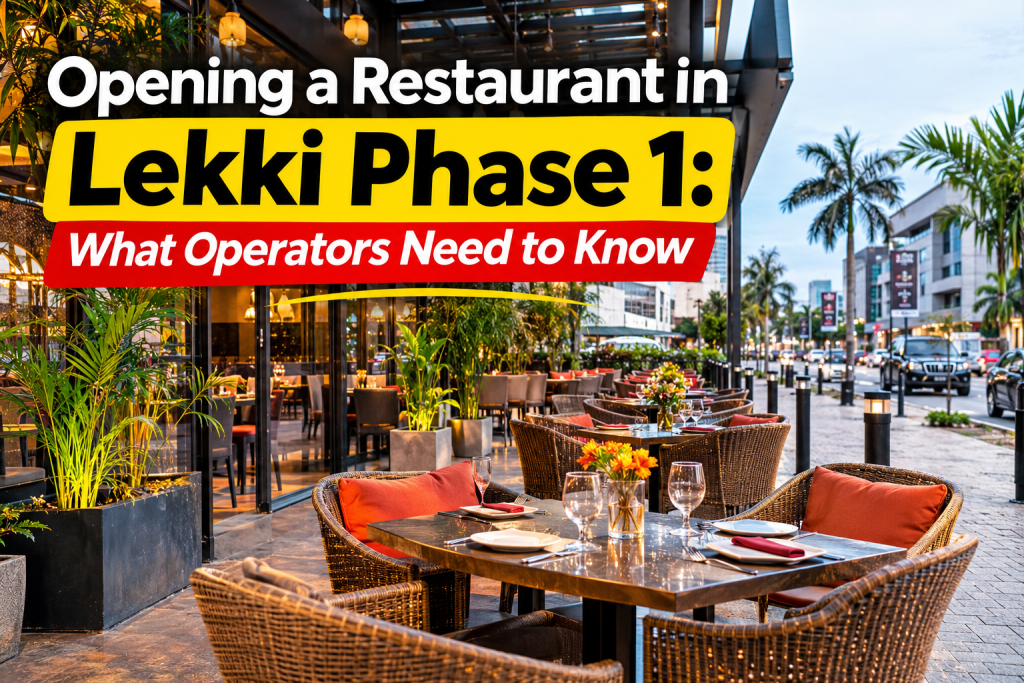
Opening a Restaurant in Lekki Phase 1: What Operators Need to Know, Rent, Locations, Business Guide (2027)
Lekki Phase 1 is one of Lagos’s most attractive destinations for restaurants, cafés, grills and lifestyle dining businesses. Its combination of residential communities, offices, shopping destinations and social activities creates opportunities for food entrepreneurs. However, high rental expectations and intense competition make property selection critical. This guide explains where to look, what rent may cost and how to choose a property that supports profitability.
Why Open a Restaurant in Lekki Phase 1?
Lekki Phase 1 has developed into an important residential, commercial and lifestyle destination in Lagos. Its customer base includes professionals, business owners, families, young adults, expatriates and visitors from neighbouring areas.
This creates opportunities for restaurant operators serving different customer segments.
A restaurant in Lekki Phase 1 may attract:
- Professionals looking for breakfast and lunch.
- Residents seeking convenient everyday dining.
- Families meeting for weekend meals.
- Social groups looking for grills, cafés and evening dining.
- Customers ordering food through delivery platforms.
- Visitors exploring the neighbourhood’s hospitality and leisure businesses.
However, a Lekki Phase 1 address does not automatically guarantee strong sales. Your exact street, property frontage, parking, accessibility, menu pricing and customer experience will determine how commercially attractive the location becomes.
1. Best Restaurant Hotspots in Lekki Phase 1
Not every street in Lekki Phase 1 offers the same commercial advantages. Some locations are better suited to walk-in restaurants, while others may work better for destination dining, cafés or delivery-focused businesses.
A. Admiralty Way
Admiralty Way is one of the prominent commercial and lifestyle corridors in Lekki Phase 1.
The surrounding environment includes restaurants, retail businesses, hospitality establishments and residential developments.
Suitable restaurant concepts:
- Modern Nigerian restaurants.
- Premium casual dining.
- International cuisine.
- Grills and lounges.
- Cafés and dessert shops.
Commercial advantage: Potential exposure to residents, professionals and customers visiting nearby commercial and leisure establishments.
What operators should consider: Competition, rental expectations, parking availability and access during busy periods. A property with good visibility but difficult parking may lose customers to more convenient alternatives.
B. Freedom Way
Freedom Way is worth investigating for restaurants targeting residents, professionals and customers travelling around Lekki Phase 1.
Suitable concepts:
- Quick-service restaurants.
- Family dining.
- Cafés and bakeries.
- Casual Nigerian restaurants.
- Takeaway and delivery outlets.
Commercial advantage: Potential access to surrounding residential and commercial activity.
What operators should consider: Compare the property’s frontage, pedestrian access, road visibility and proximity to complementary businesses. Not every unit on Freedom Way has the same customer exposure.
C. Fola Osibo Road
Fola Osibo Road is a recognised commercial and lifestyle location within Lekki Phase 1.
It is worth investigating for operators looking to establish restaurants that benefit from surrounding retail, hospitality and leisure activity.
Suitable concepts:
- Restaurants and grills.
- Cafés and dessert outlets.
- Premium casual dining.
- Social dining concepts.
- Food delivery brands.
Commercial advantage: Potential access to customers already visiting the area for dining and leisure.
What operators should consider: Competition can be significant. Study the existing restaurant mix, menu prices and customer traffic before leasing.
D. Admiralty Way–Lekki Link Road Connections
Properties around connecting commercial streets and access routes can offer alternatives to prominent main-road locations.
Suitable concepts:
- Affordable restaurants.
- Takeaway businesses.
- Quick-service food outlets.
- Cloud kitchens.
- Neighbourhood cafés.
Commercial advantage: Some secondary locations may offer more manageable rental commitments while remaining accessible to Lekki Phase 1 customers.
What operators should consider: Check whether customers can find the premises easily and whether delivery riders can access it conveniently.
E. Residential and Neighbourhood Commercial Clusters
Some restaurant opportunities exist away from the busiest commercial streets.
A restaurant serving nearby households may generate repeat purchases without depending entirely on passing traffic.
Suitable concepts:
- Family restaurants.
- Everyday Nigerian meals.
- Bakeries.
- Breakfast and lunch outlets.
- Neighbourhood takeaway businesses.
Commercial advantage: The possibility of building customer loyalty within a defined residential catchment.
What operators should consider: Investigate actual residential occupancy, household purchasing power, competing restaurants and the convenience of accessing the property.
2. How Much Does Restaurant Space Cost in Lekki Phase 1?
Restaurant rental prices in Lekki Phase 1 vary according to street, frontage, building quality, floor area, parking, facilities and permitted use.
For preliminary budgeting, an indicative screening range of ₦150,000–₦300,000 per sqm annually can be used for selected commercial retail premises. This is not an average of current restaurant leases. Prime properties and specialised hospitality spaces may command higher rents, while secondary locations may be available below this range.
Illustrative annual rent calculations
| Property size | At ₦150,000/sqm | At ₦250,000/sqm |
|---|---|---|
| 50 sqm | ₦7.5 million | ₦12.5 million |
| 75 sqm | ₦11.25 million | ₦18.75 million |
| 100 sqm | ₦15 million | ₦25 million |
| 150 sqm | ₦22.5 million | ₦37.5 million |
| 200 sqm | ₦30 million | ₦50 million |
These calculations help establish preliminary budgets. They are not quotations for available properties.
What about service charges?
Some commercial developments charge separately for security, waste collection, cleaning, common-area maintenance and facility management.
For example, consider a 100 sqm restaurant with:
- Annual rent: ₦18 million.
- Illustrative service charge: ₦2.5 million annually.
- Combined annual rent and service charge: ₦20.5 million.
This excludes utilities, agency and legal fees, kitchen fit-out and other expenses.
Always request a written schedule of charges before negotiating.
3. What Type of Restaurant Should You Open in Lekki Phase 1?
The most suitable restaurant concept depends on your target customers and financial capacity.
| Restaurant concept | Potential customer market |
|---|---|
| Premium Nigerian restaurant | Professionals, residents and visitors |
| International restaurant | Premium diners and hospitality customers |
| Café and bakery | Professionals, shoppers and residents |
| Grill and lounge | Evening and weekend customers |
| Quick-service restaurant | Workers, residents and takeaway customers |
| Family restaurant | Households and social groups |
| Dessert and ice cream shop | Young adults, families and leisure customers |
| Cloud kitchen | Online food customers across delivery zones |
One attractive approach is to combine dine-in, takeaway and delivery operations.
This allows a restaurant to serve customers who want to enjoy the premises while also reaching customers who prefer eating at home or in their offices.
However, the property must support all three activities through adequate kitchen space, packaging areas and delivery collection arrangements.
4. Seven Things to Check Before Renting Restaurant Space in Lekki Phase 1
- Customer demand: Identify the residential communities, offices, retail businesses and leisure destinations surrounding the property.
- Visibility and accessibility: Examine road frontage, signage opportunities, pedestrian movement, parking and customer entry points.
- Total rental cost: Calculate annual rent, service charges, applicable agency and legal fees, utilities and maintenance.
- Kitchen infrastructure: Inspect electrical capacity, water supply, drainage, ventilation, extraction and cold storage.
- Competition: Study nearby restaurants, their menus, prices, customer traffic and service quality to identify gaps in the market.
- Landlord permissions: Obtain written approval for restaurant operations, cooking, signage, generator use, extraction systems and alterations.
- Lease protection: Negotiate suitable lease duration, rent review, renewal rights, fit-out permissions and termination provisions.
5. Understanding Landlords and Commercial Lease Negotiations in Lekki Phase 1
Lekki Phase 1 has several types of commercial landlords.
Some own standalone commercial buildings, while others lease retail spaces within shopping developments, mixed-use properties and managed commercial complexes.
Understanding the landlord’s expectations can make the leasing process easier.
What landlords may want to know
A prospective landlord may ask about:
- Your restaurant concept and menu.
- Your business experience.
- Available capital and financial capacity.
- Proposed opening date.
- Expected operating hours.
- Kitchen equipment and renovation requirements.
- Waste management and security arrangements.
Prepare a short restaurant business profile before approaching landlords. It should explain your proposed operations and demonstrate that you have considered the property’s requirements.
Important lease terms to negotiate
Lease duration: Choose a tenancy period that gives you sufficient time to recover substantial fit-out expenditure.
Rent review: Understand how and when rent can increase.
Fit-out period: Negotiate reasonable time to install equipment and complete approved renovations.
Permitted use: Ensure the lease specifically allows restaurant operations and your intended cooking activities.
Service charges: Request a transparent breakdown and clarification of future adjustments.
Repairs and maintenance: Define responsibility for structural repairs, plumbing, drainage, electrical systems and common facilities.
Renewal rights: Establish whether you can renew the lease and how renewal terms will be determined.
Have a qualified Nigerian property lawyer review the agreement before signing.
6. Restaurant Property Requirements: What Must the Building Have?
Not every commercial shop in Lekki Phase 1 is suitable for a restaurant.
A property designed for retail or office use may require significant upgrades before it can support commercial cooking.
Essential infrastructure
Electricity: Confirm that the electrical capacity can support ovens, refrigerators, freezers, air conditioners, lighting and other equipment.
Backup power: Establish whether generators, inverters or alternative power arrangements are available and permitted.
Water: Verify the reliability of the water supply, storage and pumping systems.
Drainage: Inspect wastewater capacity and suitable grease management facilities.
Ventilation: Confirm that commercial kitchen extraction and fresh-air systems can be installed.
Fire safety: Assess emergency exits, fire protection and cooking-equipment safety requirements.
Waste management: Establish arrangements for food waste, packaging and used cooking oil.
Delivery access: Confirm that riders and suppliers can reach the premises conveniently.
These issues should be assessed before paying rent because the cost of correcting unsuitable infrastructure can be substantial.
7. How Much Capital Do You Need to Open a Restaurant in Lekki Phase 1?
The amount required depends on the restaurant’s size, concept, fit-out standard, kitchen equipment and rental arrangement.
Below is an illustrative budget for a restaurant occupying approximately 100 sqm. These figures are planning assumptions, not market quotations.
| Cost category | Illustrative budget |
|---|---|
| Annual rent | ₦18 million |
| Agency, legal and other transaction costs | ₦3.6 million |
| Interior fit-out and renovation | ₦12 million |
| Kitchen equipment | ₦10 million |
| Furniture and customer facilities | ₦4 million |
| Power and electrical upgrades | ₦4 million |
| Initial inventory and working capital | ₦8 million |
| Illustrative total | ₦59.6 million |
Actual costs may be lower or significantly higher.
A fitted restaurant with suitable kitchen infrastructure may reduce the initial investment. An empty commercial shell may require substantial renovation and equipment installation.
Do not use all your capital on rent and interior design. Preserve enough working capital to cover salaries, ingredients, utilities, marketing and other operating expenses after opening.
8. How to Make a Restaurant in Lekki Phase 1 Profitable
A good location is only one part of the equation. Your restaurant must operate efficiently and deliver a consistent customer experience.
Consider these strategies:
- Develop a menu that reflects the purchasing power of your target customers.
- Offer lunch packages for nearby professionals.
- Combine dine-in, takeaway and delivery where the property supports them.
- Monitor food costs and reduce ingredient waste.
- Use customer loyalty programmes to encourage repeat visits.
- Track sales by day, time and menu category.
- Review rent and other occupancy costs against revenue monthly.
Calculate your restaurant’s occupancy cost
Suppose annual rent and service charges total ₦20 million, while annual restaurant revenue is ₦200 million.
₦20 million ÷ ₦200 million × 100 = 10% occupancy cost.
This is an illustrative calculation, not a universal restaurant benchmark. Your sustainable occupancy cost will depend on food margins, labour, utilities and other operating expenses.
The objective is to ensure that property costs do not consume the money required to operate and grow the business.
How UPG REALESTATE COMMERCIAL ADVISORS Can Help
Finding restaurant space in Lekki Phase 1 requires more than locating an available shop.
Restaurant operators need to understand the relationship between location, rent, customer demand, infrastructure, landlord permissions and long-term operating costs.
UPG REALESTATE COMMERCIAL ADVISORS (+234-80-8460-1194) supports restaurant operators, food entrepreneurs, landlords and investors through:
- Restaurant and retail property sourcing.
- Commercial location analysis.
- Tenant representation.
- Commercial rent benchmarking.
- Landlord advisory.
- Commercial lease evaluation and negotiation.
- Property due diligence.
- Restaurant expansion and site selection.
Whether you are opening your first restaurant, relocating an existing brand or expanding into Lekki Phase 1, a structured property selection process can help reduce leasing risks and improve your investment decisions.
Conclusion
Lekki Phase 1 offers opportunities for restaurant entrepreneurs targeting professionals, residents, families and lifestyle customers. Commercial corridors such as Admiralty Way, Freedom Way and Fola Osibo Road are worth investigating, alongside suitable secondary streets and neighbourhood commercial clusters.
However, choosing a prestigious address is not enough.
Before leasing, examine customer demand, compare rental costs, inspect kitchen infrastructure, assess competition and negotiate a lease that protects your investment.
The best restaurant property in Lekki Phase 1 is not necessarily the most expensive or busiest one. It is the property that connects your restaurant to the right customers while keeping occupancy costs and operating risks under control.
Frequently Asked Questions (FAQs)
1. How much does it cost to rent a restaurant space in Lekki Phase 1?
Restaurant rent depends on the street, property size, frontage, building quality and available infrastructure. For preliminary budgeting, selected commercial retail properties may be screened using an indicative range of ₦150,000–₦300,000 per sqm annually. A 100 sqm property would imply ₦15 million–₦30 million annual rent. Actual quotations can vary significantly, and additional service charges may apply.
2. What is the best street to open a restaurant in Lekki Phase 1?
Admiralty Way, Freedom Way and Fola Osibo Road are among the locations worth investigating. Each has different commercial characteristics and customer opportunities. Your ideal street depends on whether you are opening a premium restaurant, family dining outlet, café, grill or takeaway business. Examine the specific property, customer access, parking and competition before making a decision.
3. Is Lekki Phase 1 suitable for a small restaurant startup?
Yes. However, startups should carefully manage rent and fit-out expenditure. Consider smaller premises, suitable secondary streets or existing fitted restaurant spaces to reduce initial capital requirements. A compact café, takeaway restaurant or specialised food outlet may be more financially manageable than leasing a large restaurant property immediately.
4. What should I check before leasing a restaurant property in Lekki Phase 1?
Check permitted use, landlord authority, rent, service charges, lease duration, renewal rights, electricity, backup power, water, drainage, kitchen extraction, ventilation, fire safety, parking and delivery access. Also confirm whether the landlord permits your proposed alterations. Have qualified professionals inspect the building and a property lawyer review the lease before signing.
5. How can I find landlords with restaurant properties available in Lekki Phase 1?
You can approach commercial property advisers, letting agents, property managers and landlords with suitable retail or hospitality premises. When making enquiries, specify your restaurant concept, preferred floor area, annual rent budget, required kitchen infrastructure and proposed opening date. UPG REALESTATE COMMERCIAL ADVISORS can assist with sourcing suitable commercial premises, assessing location suitability and evaluating lease terms.