
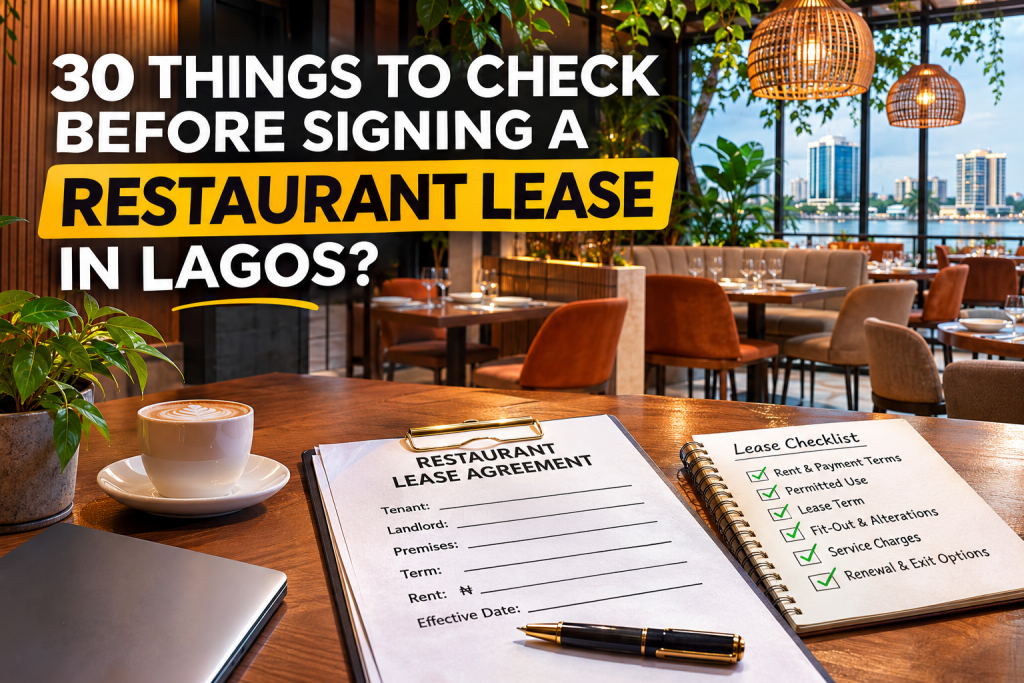
Planning to rent a restaurant space in Lagos? Discover 30 essential things to check before signing a commercial lease, from rent and permitted use to kitchen facilities, power, drainage and exit clauses.
30 Things to Check Before Signing a Restaurant Lease in Lagos
Opening a restaurant in Lagos is an exciting business opportunity, but choosing the wrong commercial property can turn your investment into an expensive mistake. Beyond rent and location, restaurant operators must examine building infrastructure, permitted use, kitchen suitability, lease conditions and hidden costs. This practical checklist explains 30 things to inspect and negotiate before committing to a restaurant property.
Why You Must Inspect a Restaurant Property Before Signing a Lease
A restaurant is not an ordinary retail business. It requires specialised facilities for cooking, food storage, ventilation, water supply, drainage, electricity, waste disposal and customer access.
A property that works perfectly for a clothing shop or office may be unsuitable for a restaurant.
Imagine renting a shop in Lekki Phase 1, spending millions of naira on kitchen equipment and interior design, and discovering that the landlord does not permit commercial extraction systems or heavy cooking. Your investment could be delayed or wasted.
Before committing to a property in Lekki, Victoria Island, Ikeja, Yaba, Surulere, Ikoyi or Ajah, examine the following 30 items.
30 Things to Check Before Signing a Restaurant Lease in Lagos
A. Location and Commercial Suitability
1. Location and Target Customer Demand
Does the neighbourhood contain the customers your restaurant needs?
Investigate nearby offices, residential estates, hotels, universities, shopping centres and entertainment destinations.
For example, a premium restaurant targeting professionals may investigate Victoria Island or Lekki Phase 1, while an affordable food outlet may find suitable opportunities in Yaba, Surulere or selected parts of Ikeja.
2. Road Accessibility and Visibility
Check whether customers can easily locate and access the property.
Examine road conditions, traffic congestion, pedestrian movement, entry and exit routes, and visibility from the road. A restaurant hidden behind several buildings may struggle to attract walk-in customers.
3. Parking Availability
Restaurants need convenient parking, particularly when targeting families, groups and premium customers.
Confirm the number of available parking spaces, whether parking is shared, whether customers pay separately and whether neighbouring businesses compete for the same spaces.
4. Competition Around the Property
Identify restaurants operating within approximately 500 metres to 1 kilometre of the proposed location.
Study their menus, prices, customer activity, delivery services and reviews.
Competition is not always negative. Several successful restaurants may indicate established food demand, but you need a clear reason customers should choose your business.
5. Permitted Commercial Use
Confirm that the landlord and applicable property authorities permit your intended restaurant activities.
Do not assume that a property advertised as commercial automatically permits cooking, food production, late-night operations, alcohol service or commercial kitchen installations.
Obtain relevant permissions in writing and verify applicable planning and environmental requirements.
B. Rent, Payments and Financial Obligations
6. Annual Rent and Payment Structure
Confirm the exact annual rent, payment frequency, currency, payment date and method.
In Lagos, some landlords request one or more years’ rent in advance. Make sure the payment structure matches your cash flow and working capital requirements.
7. Agency, Legal and Other Transaction Fees
Ask for a complete breakdown of all fees before making payment.
Establish whether agency fees, legal fees, caution deposits, documentation charges and other costs apply. Confirm the basis on which each fee is calculated and obtain receipts.
8. Service Charges and Estate Fees
Find out whether the property attracts additional charges for security, cleaning, waste collection, common-area maintenance, water or facility management.
Request a breakdown of the charges and clarify whether they are fixed, variable or subject to annual review.
9. Rent Review and Escalation Clauses
Check whether the landlord can increase rent during the tenancy or at renewal.
Understand when rent reviews occur, how increases are calculated and whether the landlord has unrestricted discretion.
Negotiate clear and predictable rent review terms to protect your long-term operating budget.
10. Hidden Costs and Financial Obligations
Ask about costs that may not appear in the advertised rent.
These may include generator contributions, parking fees, repairs, security charges, utility deposits, waste disposal and mandatory facility upgrades.
Calculate the full cost of occupying the property before deciding whether it is affordable.
C. Kitchen Infrastructure and Building Condition
11. Electricity Capacity and Power Supply
Commercial kitchens require substantial electricity for refrigeration, freezers, air conditioning, ovens, lighting, water pumps and other equipment.
Ask about the available electrical capacity, distribution board condition, wiring, metering arrangements and the cost of any required upgrades.
Have a qualified electrician assess the installation before signing.
12. Generator and Alternative Power Arrangements
Confirm whether the building has a generator, inverter or other backup power system.
Determine whether your restaurant can use it, what equipment it can support, who pays for fuel and maintenance, and whether there are restrictions on generator operating hours.
Do not assume an existing generator can handle your entire kitchen.
13. Water Supply and Storage
Restaurants need reliable water for food preparation, cleaning, handwashing and sanitation.
Inspect the water source, storage tanks, pumping system and water quality. Establish whether the supply is shared with other tenants and who pays for maintenance.
14. Drainage and Wastewater Disposal
Poor drainage can create unpleasant odours, flooding, pest problems and hygiene risks.
Inspect floor drains, external drainage channels, sewage arrangements and grease management facilities.
Confirm that the property can accommodate the wastewater generated by your expected kitchen operations.
15. Kitchen Ventilation and Exhaust Systems
Cooking produces heat, steam, smoke, grease and odours.
Check whether the property has suitable ventilation and extraction infrastructure. If you need to install ducts or extraction equipment, obtain written permission and confirm where the exhaust can safely discharge.
This is particularly important in shopping complexes and multi-tenant buildings.
16. Floor Condition and Kitchen Suitability
Inspect floors, walls and ceilings for cracks, leaks, dampness and other defects.
Restaurant kitchens require surfaces that can be cleaned effectively and withstand the demands of commercial operations.
Assess whether the existing layout can support your preparation stations, cooking equipment, storage and staff movement.
17. Ceiling Height and Internal Space
Check whether the ceiling height and internal dimensions can accommodate your equipment, extraction ducts, lighting and ventilation requirements.
Measure the actual usable space rather than relying only on the advertised square metres.
A property may appear spacious until refrigeration, counters, tables and kitchen equipment are installed.
D. Customer Experience and Operational Requirements
18. Toilets and Customer Facilities
If your restaurant will accommodate dine-in customers, inspect the availability and condition of toilets and handwashing facilities.
Confirm whether they are private or shared, how they are maintained and whether the number and accessibility are appropriate for your intended operation.
19. Fire Safety and Emergency Access
Inspect fire extinguishers, emergency exits, escape routes, electrical safety and other relevant fire protection arrangements.
Commercial kitchens may require additional fire safety measures depending on the equipment and cooking methods used.
Have a qualified professional assess the premises and verify applicable requirements before occupation.
20. Waste Disposal Arrangements
Restaurants generate food waste, packaging, cooking oil and other refuse.
Find out where waste is stored, how frequently it is collected and who is responsible for disposal.
Ensure that waste arrangements will not create odours, attract pests or interfere with customer access.
21. Internet and Telecommunications
Modern restaurants use internet connectivity for POS systems, online ordering, payment processing, inventory management, CCTV and delivery platforms.
Test network coverage inside the property and identify reliable broadband or mobile alternatives.
22. Delivery Rider and Supplier Access
If you offer delivery, inspect how riders will collect completed orders.
Check whether there is a designated collection point, safe waiting area and convenient access for motorcycles and supplier vehicles.
Poor dispatch arrangements can cause congestion, delayed orders and unnecessary customer complaints.
23. Security and Operating Hours
Understand the building’s security arrangements, access controls and operating-hour restrictions.
Some commercial estates and shopping complexes restrict late-night operations, generator use, deliveries or customer access.
Confirm that these restrictions are compatible with your restaurant’s business model.
E. Lease Agreement and Legal Protection
24. Landlord’s Ownership and Authority to Lease
Verify the identity of the landlord and confirm that the person signing the agreement has the legal authority to lease the premises.
Where the property is represented by an agent, request appropriate evidence of the owner’s authorisation.
Have a qualified property lawyer review relevant ownership and title documents.
25. Lease Duration and Renewal Rights
Check the tenancy period, commencement date, expiry date and conditions for renewal.
If you intend to invest significantly in kitchen equipment and interior improvements, a very short or uncertain tenancy may expose you to substantial financial risk.
Negotiate renewal provisions that provide reasonable security for your investment.
26. Permitted Alterations and Fit-Out Rights
Your restaurant may require plumbing, electrical upgrades, kitchen extraction, counters, partitions, signage, refrigeration and other modifications.
The lease should clearly state which alterations are permitted, whether landlord approval is required and who owns improvements at the end of the tenancy.
Obtain written consent before carrying out major work.
27. Repairs and Maintenance Responsibilities
Clarify who is responsible for structural repairs, roofing, plumbing, electrical installations, drainage, generator maintenance and other building systems.
Do not accept vague clauses that leave responsibility for expensive repairs uncertain.
Record existing defects before taking possession.
28. Termination, Default and Exit Conditions
Understand the circumstances in which the landlord can terminate the lease and the notice requirements.
Review default provisions, outstanding payment obligations, dispute resolution and any early termination rights available to the tenant.
You should also understand what happens to your equipment, fixtures and improvements when the tenancy ends.
29. Subletting, Assignment and Change of Business
Find out whether you can transfer the lease, introduce a business partner, sublet part of the premises or change the restaurant concept.
These provisions may become important if your business expands, restructures or attracts an investor.
Obtain clear written terms rather than relying on verbal assurances.
30. Handover Condition and Written Documentation
Before taking possession, document the property’s condition with photographs, videos, inspection reports and a signed inventory where appropriate.
Record meter readings, keys handed over, equipment provided, outstanding defects and agreed repairs.
Ensure that the final lease reflects the terms negotiated with the landlord. Keep signed copies of all relevant documents and payment evidence.
7 Important Things Every Restaurant Tenant Must Remember
Before signing, pay particular attention to these seven principles:
- Verify before paying: Confirm ownership, authority to lease and permitted use before transferring substantial funds.
- Calculate total occupancy cost: Rent is only one part of the financial commitment. Include fees, service charges, utilities and fit-out.
- Inspect technical infrastructure: Electricity, water, drainage, ventilation and fire safety can determine whether the property is operationally suitable.
- Get permissions in writing: Do not rely on verbal promises about cooking, extraction, signage, alterations or operating hours.
- Protect your investment: Negotiate appropriate lease duration, renewal rights and ownership of improvements.
- Document the property condition: Record defects and agreed repairs before occupation.
- Use professional advisers: Have a qualified lawyer and relevant technical professionals review the lease and premises before committing.
How to Evaluate a Restaurant Property Before Leasing
Create a property comparison sheet for every location you inspect.
For example, if you are comparing three restaurant properties in Lekki Phase 1, Victoria Island and Ikeja, score each property against the same criteria.
| Evaluation factor | Suggested score |
|---|---|
| Customer demand and location | 20 |
| Total occupancy cost | 20 |
| Kitchen infrastructure | 20 |
| Accessibility and parking | 10 |
| Lease terms and legal protection | 15 |
| Delivery and supplier access | 10 |
| Expansion potential | 5 |
| Total | 100 |
The scores are an illustrative decision-making framework, not a market valuation. A property with the highest score should still pass all essential legal, safety and operational checks.
How UPG REALESTATE COMMERCIAL ADVISORS Can Help
Finding a restaurant property in Lagos involves more than searching for an available shop or negotiating annual rent.
Restaurant operators need premises that support their business concept, customer demand, kitchen infrastructure, delivery operations and long-term financial objectives.
UPG REALESTATE COMMERCIAL ADVISORS supports commercial property sourcing, tenant representation, location assessment, lease evaluation and commercial property due diligence.
Whether you are opening your first restaurant in Yaba, expanding a food brand in Lekki Phase 1 or securing a premium restaurant space in Victoria Island, a structured property selection process can help you avoid costly leasing mistakes.
Conclusion
Signing a restaurant lease is one of the most important decisions you will make as a food entrepreneur. The wrong property can increase operating expenses, delay your opening, create legal disputes and restrict future expansion.
Before committing to any commercial property in Lagos, inspect all 30 items in this checklist. Examine the building, understand the financial obligations, verify permitted use and negotiate lease terms that protect your business.
Remember: A restaurant’s success does not begin when the first customer walks through the door. It begins when you choose the right property and sign the right lease.
Frequently Asked Questions
1. What should I check before renting a restaurant space in Lagos?
Check the property’s location, customer demand, annual rent, additional fees, permitted use, electricity, water, drainage, kitchen ventilation, parking, security, waste disposal and delivery access. You should also verify the landlord’s authority, inspect the lease duration and renewal terms, and obtain legal advice before signing.
2. Can I convert an ordinary commercial shop into a restaurant in Lagos?
Possibly, but not every commercial shop is suitable for restaurant operations. You need to confirm that the proposed food business is permitted and that the building can support cooking, extraction, ventilation, water, drainage, electrical loads and fire safety requirements. Obtain the landlord’s written approval for alterations and verify applicable regulatory requirements before starting renovations.
3. Who is responsible for repairs and maintenance in a commercial restaurant lease?
Responsibility depends on the lease agreement. Some agreements place structural repairs on the landlord while assigning routine maintenance and tenant-installed equipment to the tenant. However, these arrangements vary. Clearly document responsibility for roofing, plumbing, electrical systems, drainage, generators, ventilation and other essential facilities before signing.
4. How long should a restaurant lease be in Lagos?
The appropriate lease duration depends on your business model, fit-out investment, location and expected payback period. A restaurant investing heavily in kitchen infrastructure and interior design may need a longer and more secure tenancy than a small takeaway outlet. Consider renewal rights, rent review clauses and termination provisions when negotiating the duration.
5. Can I negotiate the rent and other terms of a restaurant lease?
Yes. Depending on the landlord’s willingness and the commercial circumstances, you can negotiate annual rent, payment structure, rent review, lease duration, renewal rights, fit-out permissions, service charges, repairs and exit provisions. Do not focus exclusively on reducing rent. Securing favourable terms that protect your investment and operating flexibility may be equally valuable.