
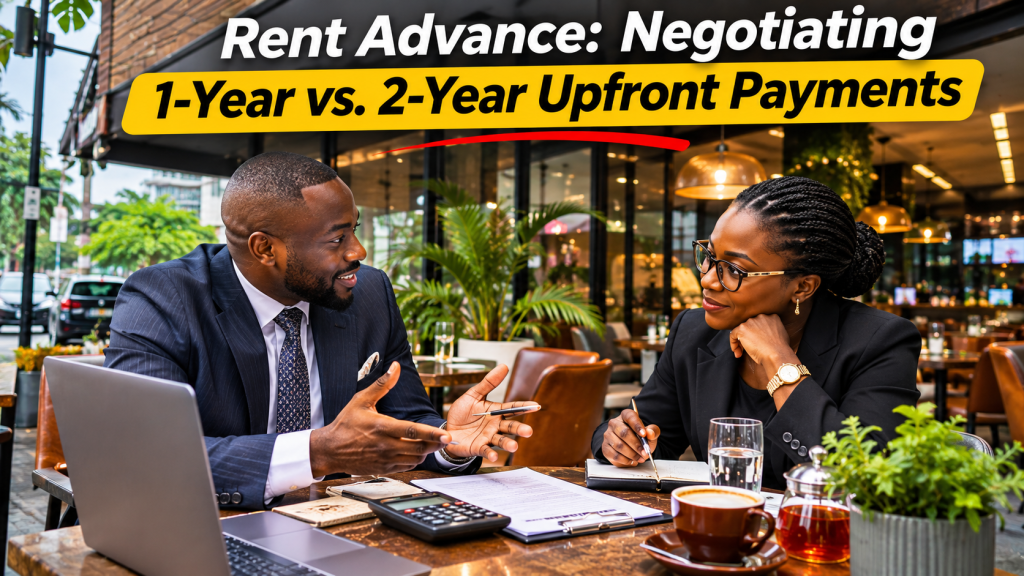
Should Lagos restaurant operators pay one or two years’ rent upfront? Learn how to negotiate rent advance, protect cash flow, secure landlord concessions and structure a better commercial lease.
The decision to pay one or two years’ rent upfront can shape a restaurant’s financial future. In Lagos, where landlords may prefer substantial advance payments and operators need cash for equipment, staffing, inventory and marketing, the wrong arrangement can put pressure on a business before it gains momentum. This guide explains how to negotiate a rent advance that protects both the tenant and landlord.
Why Rent Advance Is a Major Negotiation Issue in Lagos
Rent advance is the rent a tenant pays before or at the beginning of a tenancy for an agreed rental period. In Lagos commercial property transactions, landlords may request one year, two years or another agreed payment structure, depending on the property, location, tenant profile and negotiation.
For restaurant operators, the amount paid upfront is only part of the cost of securing a property. A restaurant in Lekki Phase 1, Victoria Island, Ikoyi, Ikeja GRA or Yaba may also require agency fees, legal fees, caution deposits, service charges, power deposits, renovation expenses and equipment purchases.
Consider a restaurant space with an annual rent of ₦12 million.
- One-year advance: ₦12 million.
- Two-year advance: ₦24 million.
- Additional cash committed under the two-year option: ₦12 million.
That extra ₦12 million could otherwise fund kitchen equipment, staff salaries, food inventory, branding, delivery operations or working capital.
However, a landlord may be willing to offer a lower annual rent, longer lease security or other concessions in exchange for a two-year commitment. The question is not simply which option is cheaper. It is which arrangement creates the best overall financial outcome.
1-Year vs. 2-Year Rent Advance: What Is the Difference?
A one-year advance means the tenant pays for the first 12 months of the agreed tenancy. A two-year advance means the tenant pays for 24 months upfront.
| Consideration | 1-year advance | 2-year advance |
|---|---|---|
| Initial cash requirement | Lower | Higher |
| Working capital | More cash remains available | More cash is tied up |
| Landlord certainty | One year secured | Two years secured |
| Rent review exposure | May arise sooner, subject to lease | May be deferred if expressly agreed |
| Flexibility | Generally greater | Less flexibility |
| Negotiating leverage | Depends on demand and tenant strength | May support requests for concessions |
| Business risk | Less cash committed upfront | More exposure if the business fails or property becomes unsuitable |
Neither option is automatically better. The right choice depends on the restaurant’s financial position, the property’s commercial potential and the exact lease terms.
The Financial Impact: An Illustrative Lagos Restaurant Example
Imagine a restaurant considering a property in Lekki Phase 1 with an annual rent of ₦12 million.
The landlord offers two alternatives:
Option A: One-year advance
- Annual rent: ₦12 million.
- Rent paid upfront: ₦12 million.
- Cash retained compared with the two-year option: ₦12 million.
Option B: Two-year advance
- Annual rent: ₦12 million.
- Rent paid upfront: ₦24 million.
- Additional cash committed: ₦12 million.
Now imagine the restaurant needs ₦8 million for kitchen equipment, ₦3 million for furnishing, ₦2 million for opening inventory and ₦3 million for launch marketing and working capital.
That is another ₦16 million in planned expenditure, before considering other costs.
If the operator chooses the two-year option, the business must be able to fund both the ₦24 million rent advance and the remaining setup costs without exhausting its operating reserve.
A restaurant can have an excellent location and still struggle because too much of its capital is locked into the property.
When Should a Restaurant Choose a 1-Year Rent Advance?
A one-year advance is often the more practical option for startups, SMEs and restaurant operators testing a new market.
It can be particularly useful when:
- The restaurant is opening its first physical outlet.
- The business has limited working capital.
- The location has not been commercially tested.
- The operator is uncertain about customer demand.
- The property requires significant renovation.
- The restaurant wants to preserve funds for marketing and operations.
For example, a new food business opening in Yaba may want to test demand, delivery volumes and customer spending before committing substantial capital to a long-term location.
A one-year arrangement allows the operator to review performance before making another major rent commitment. However, this flexibility is only valuable if the lease provides clear renewal terms and reasonable protection against unexpected rent increases or non-renewal.
When Does a 2-Year Rent Advance Make Commercial Sense?
Paying two years upfront may be reasonable when the property has strong commercial potential and the landlord provides meaningful benefits in return.
Consider a restaurant seeking a high-visibility location on a busy commercial road in Victoria Island. The operator may want long-term occupancy security because relocating could mean losing customers, brand visibility and substantial fit-out investment.
A two-year advance may make sense where:
- The restaurant has reliable cash reserves.
- The location has been properly assessed.
- The lease provides sufficient security of tenure.
- The landlord offers a genuine rent discount.
- The agreed rent is protected from increases during the prepaid period.
- The restaurant has enough money left for operations and emergencies.
The important point is that paying two years upfront should be a negotiated commercial decision, not simply a response to a landlord’s demand.
7 Practical Strategies for Negotiating 1-Year vs. 2-Year Upfront Payments
These strategies can help tenants secure better terms while giving landlords confidence in the tenant’s ability to meet its obligations.
- Offer a shorter advance with stronger documentation: If you prefer one year, demonstrate financial capacity through company records, references, business plans or a credible guarantor where appropriate.
- Exchange a longer advance for a rent discount: If the landlord requests two years, negotiate a reduction in the annual rent or another measurable financial benefit.
- Request rent protection: Make sure the lease clearly states whether rent can be reviewed during the prepaid period. Seek written confirmation that no additional rent will be demanded for that period.
- Negotiate staged payment arrangements: Propose an initial payment followed by an agreed instalment schedule, if the landlord is willing. Record every due date and consequence of late payment in the lease.
- Secure renewal rights: Negotiate a clear renewal option, notice period and rent review mechanism so that you are not exposed to sudden uncertainty after investing in the restaurant.
- Separate rent from other charges: Ask for a written breakdown of agency fees, legal fees, caution deposits, service charges, power costs, waste management and other expenses.
- Use property condition as leverage: Where the premises require repairs, electrical upgrades, plumbing work, ventilation improvements or other landlord responsibilities, negotiate who pays and whether the work will be completed before rent commencement.
How Landlords Can Benefit from Offering 1-Year or 2-Year Payment Options
The negotiation should not focus only on what the tenant wants. Landlords also have legitimate financial and operational concerns.
A landlord may prefer two years upfront because it provides predictable cash flow, reduces collection activity and gives greater certainty about rental income. However, demanding a large advance can reduce the pool of qualified tenants, particularly among startups and growing SMEs.
Offering a one-year payment option can attract more operators and improve the chances of securing a suitable tenant.
For landlords with restaurant properties in Lekki, Victoria Island, Ikoyi and Ikeja GRA, a financially stable tenant who pays consistently and maintains the premises may create more long-term value than a tenant who pays two years upfront but struggles to operate.
Landlords can consider:
- Offering one-year payment to qualified tenants with strong references.
- Offering a discount for two-year advance payments.
- Providing a rent-free fit-out period where commercially justified.
- Agreeing on transparent service-charge budgets.
- Including clear maintenance responsibilities.
- Setting out rent review and renewal procedures.
A good lease should support sustainable occupancy, not just immediate cash collection.
How to Calculate Whether You Can Afford Two Years Upfront
Before accepting a two-year rent demand, prepare a cash-flow forecast.
Use this simple framework:
Available business capital – rent advance – setup costs – statutory and transaction costs – operating reserve = remaining cash.
For example:
| Item | Illustrative amount |
|---|---|
| Available capital | ₦60,000,000 |
| Two-year rent advance | ₦24,000,000 |
| Renovation and fit-out | ₦12,000,000 |
| Equipment and furniture | ₦8,000,000 |
| Initial inventory and launch | ₦4,000,000 |
| Remaining cash | ₦12,000,000 |
In this example, the business has ₦12 million remaining after the listed commitments. The operator must now determine whether that amount can cover salaries, utilities, replenishment, marketing, maintenance and other operating expenses until the restaurant generates sufficient cash.
The calculation should include a realistic contingency reserve. A restaurant that opens with almost no working capital may struggle even if its rent is relatively affordable.
Negotiation Examples: What Should You Say to the Landlord?
A tenant does not have to reject a landlord’s two-year request outright. Instead, present a commercial proposal.
Example 1: Negotiating one year upfront
“Thank you for the offer. We are interested in the property and can demonstrate our capacity to operate responsibly. We would prefer a one-year rent advance so that we can allocate sufficient capital to the fit-out and successful operation of the restaurant. We are willing to provide the necessary company documentation and agree to clear lease obligations.”
Example 2: Negotiating a two-year discount
“We can consider paying two years upfront, provided there is a corresponding commercial benefit. We would like to discuss a reduction in the annual rent and written confirmation that the rent will remain unchanged throughout the prepaid period.”
Example 3: Negotiating staged payments
“We are prepared to commit to the property, but we would like to propose an initial payment followed by an agreed second instalment. This will allow us to complete the fit-out and maintain sufficient working capital while giving you a clear payment commitment.”
These proposals are starting points. The final agreement should reflect the landlord’s position, the tenant’s financial capacity and the applicable law.
Legal and Contractual Issues to Check Before Paying
A rent advance agreement should never be based solely on a verbal understanding or an informal receipt.
Before transferring funds, confirm:
- The landlord’s authority: Verify the owner’s identity, title or authority to grant the tenancy.
- The tenancy period: State the commencement date, expiry date and exact period covered by the payment.
- Rent review: Specify when rent can be reviewed and how any increase will be determined.
- Renewal rights: State the notice required, renewal procedure and rent-setting mechanism.
- Refund and termination provisions: Clarify what happens to prepaid rent if the lease ends early, the property becomes unusable or either party breaches the agreement.
- Permitted use: Confirm that the premises can legally and practically be used for the intended restaurant or food business.
- Repairs and fit-out: Identify which party is responsible for structural repairs, electrical capacity, plumbing, ventilation and other improvements.
- Receipts and payment evidence: Obtain formal receipts and ensure payments go to the verified landlord or authorised recipient.
Important legal note: Do not assume that a two-year rent demand is automatically lawful simply because it is common in a particular market. Tenancy rules, statutory exceptions and the treatment of commercial premises can depend on the applicable state law and the nature of the tenancy. Lagos operators should have a qualified property lawyer review the proposed arrangement before payment, including whether any statutory limit or exemption applies.
Common Mistakes Tenants Make When Negotiating Rent Advance
One of the biggest mistakes is focusing entirely on the annual rent while ignoring the total cost of occupancy.
A restaurant paying ₦12 million annually may also face substantial service charges, power costs, security expenses, waste management charges and maintenance obligations. These costs can make an apparently affordable property expensive to operate.
Other mistakes include:
- Paying before verifying ownership or authority.
- Accepting two years upfront without negotiating a discount or added protection.
- Failing to document the rent review arrangement.
- Spending all available capital on rent and renovation.
- Ignoring the cost of relocating after a short lease.
- Assuming that a verbal promise to renew is legally sufficient.
- Failing to confirm that restaurant use, signage, exhaust systems and operating hours are permitted.
The best negotiation is one that considers the entire commercial relationship, not just the first payment.
What Is the Best Rent Advance Strategy for Lagos Restaurant Operators?
There is no universal answer. A startup with limited capital may benefit from one year upfront, while an established restaurant with strong reserves may find a discounted two-year arrangement attractive.
For a landlord, the objective should be to secure a reliable tenant, protect the property and maintain sustainable rental income. For the tenant, the objective should be to secure a suitable location without compromising the cash needed to operate the business.
Before committing, compare the total cost of each option, assess the property’s commercial potential, review the lease and negotiate measurable benefits for any longer advance.
UPG REALESTATE COMMERCIAL ADVISORS (+234-80-8460-1193) helps businesses assess commercial locations, evaluate occupancy costs and negotiate property arrangements that support long-term business performance. The right restaurant property is not simply the one you can afford to rent; it is the one your business can afford to occupy and operate profitably.
Frequently Asked Questions
1. Is it better to pay one year or two years’ rent upfront for a restaurant in Lagos?
It depends on the restaurant’s cash position, the property’s commercial potential and the lease protections offered. One year upfront generally preserves more working capital and gives a new operator greater flexibility. Two years may be worthwhile if the landlord offers a meaningful discount, protects the rent throughout the prepaid period and provides sufficient security of tenure. Compare the total financial impact before deciding.
2. Can I negotiate a landlord down from two years to one year upfront?
Yes. You can propose one year upfront and strengthen your offer with company documentation, references, a credible guarantor where appropriate, or evidence of financial capacity. You can also explain that retaining working capital will help the restaurant complete its fit-out and operate sustainably. The landlord is not obliged to accept, so make a commercially credible proposal and document any agreement.
3. Should a landlord give a discount for two years’ rent paid upfront?
A discount can be commercially reasonable because the landlord receives cash earlier and reduces the risk and administrative burden of collecting rent during that period. However, the discount should reflect the value of early payment and the property’s market position. Both parties should calculate the actual benefit rather than assume that two years upfront automatically deserves a particular percentage reduction.
4. What happens if my restaurant closes before the two-year prepaid rent expires?
The outcome depends on the lease, applicable law and circumstances surrounding the closure. The agreement should clearly address early termination, tenant default, landlord breach, property damage and any refund or compensation due for unused prepaid rent. Do not assume that unused rent will automatically be refunded. Have a lawyer negotiate clear provisions before making the payment.
5. What other costs should I negotiate besides rent advance when leasing a restaurant property in Lagos?
Review agency and legal fees, caution deposits, service charges, power and generator costs, waste management, security, maintenance, signage permissions, renovation responsibilities and any required deposits. Also negotiate the rent commencement date, fit-out period, renewal rights and rent review mechanism. A property with lower annual rent can still be more expensive if its additional occupancy costs are high.