
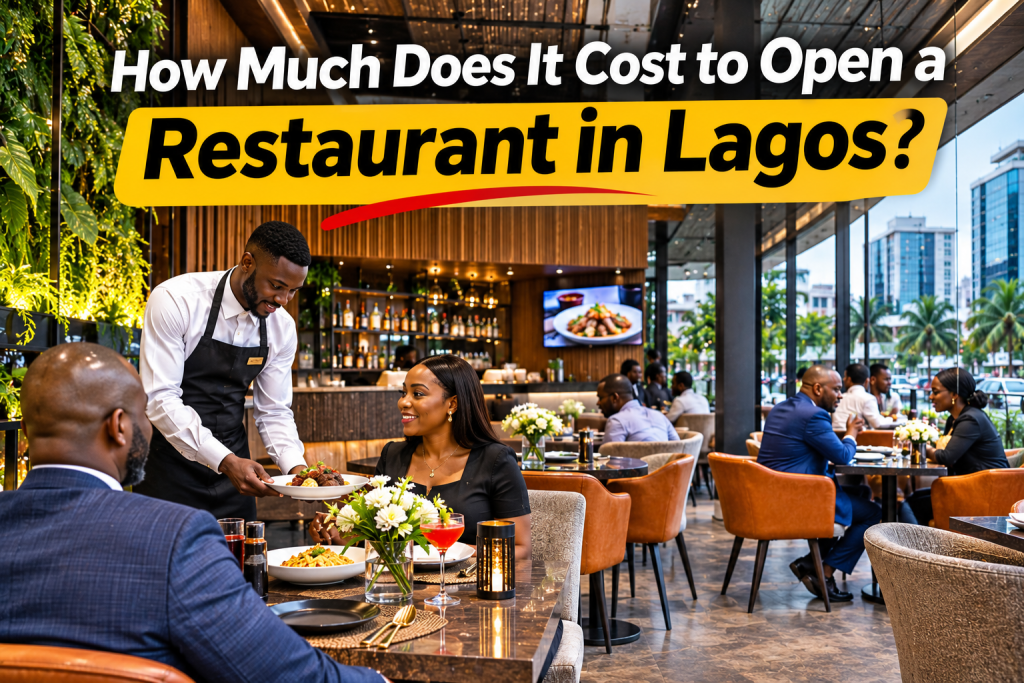
Discover how much it costs to open a restaurant in Lagos in 2027. Explore rent, kitchen equipment, renovation, staff, licenses, working capital and realistic startup budgets.
How Much Does It Cost to Open a Restaurant in Lagos? Complete 2027 Startup Cost Guide
Opening a restaurant in Lagos can require anything from a few million naira for a small takeaway operation to over ₦300 million for a premium restaurant. Your actual investment depends on location, property size, rent, kitchen equipment, interior design and working capital. This guide breaks down the major expenses and helps you prepare a realistic restaurant startup budget.
Introduction: What Does It Really Cost to Open a Restaurant in Lagos?
One of the biggest mistakes aspiring restaurant owners make is budgeting only for rent, renovation and kitchen equipment. A restaurant also needs reliable power, water, furniture, staff, inventory, marketing, regulatory compliance and enough working capital to survive the first months of operation.
A restaurant in Lekki Phase 1 will have a different financial requirement from a takeaway outlet in Yaba or a premium dining establishment in Ikoyi.
The important question is not simply how much money you need to open the doors. It is how much capital you need to open, operate and grow without running out of cash.
1. How Much Does It Cost to Open a Restaurant in Lagos?
For preliminary planning, consider these broad illustrative startup budgets:
| Restaurant type | Illustrative startup budget |
|---|---|
| Small takeaway or food outlet | ₦8m–₦20m |
| Small neighbourhood restaurant | ₦15m–₦35m |
| Mid-sized casual dining restaurant | ₦30m–₦65m |
| Premium restaurant | ₦60m–₦120m |
| Large premium or fine-dining restaurant | ₦100m–₦300m+ |
These are planning estimates, not market averages or contractor quotations. They assume different property sizes, fit-out standards, equipment requirements and working-capital provisions. An existing fitted restaurant may cost considerably less to take over than an empty commercial shell.
Your final budget should be built around the specific property, menu, seating capacity and operating model.
2. The 10 Major Costs of Opening a Restaurant in Lagos
Understanding the expenses individually makes it easier to control your investment.
A. Commercial Property Rent
Rent is one of the first major financial commitments.
The amount depends on:
- Neighbourhood and street.
- Property size.
- Ground-floor frontage.
- Parking and accessibility.
- Building condition.
- Existing restaurant infrastructure.
- Landlord’s permitted-use conditions.
For preliminary screening, the following are illustrative annual rent assumptions for selected commercial premises. They are not averages of restaurant leases.
| Location | Indicative annual rent per sqm | Illustrative rent for 100 sqm |
|---|---|---|
| Victoria Island | ₦100k–₦200k | ₦10m–₦20m |
| Lekki Phase 1 | ₦150k–₦250k | ₦15m–₦25m |
| Ikoyi | ₦150k–₦250k | ₦15m–₦25m |
| Ikeja GRA / nearby Ikeja areas | ₦80k–₦140k | ₦8m–₦14m |
| Yaba | ₦60k–₦120k | ₦6m–₦12m |
| Surulere | ₦50k–₦100k | ₦5m–₦10m |
| Ajah / Sangotedo | ₦50k–₦120k | ₦5m–₦12m |
Actual asking rents may be outside these ranges. A restaurant-ready property with good frontage, parking and infrastructure may command a premium.
Important: Do not choose a property based on rent alone. A cheaper building requiring ₦15 million in infrastructure upgrades may be more expensive overall than a fitted property with a higher rent.
B. Agency, Legal and Transaction Fees
When renting commercial premises, you may encounter additional transaction costs.
These can include:
- Agency fees.
- Legal fees.
- Caution or security deposits.
- Documentation expenses.
- Other agreed transaction charges.
For example, if annual rent is ₦15 million and agency and legal fees are each agreed at 10%, the combined fees would be ₦3 million.
Always confirm the actual fee structure and payment obligations before committing.
C. Interior Design and Renovation
Your restaurant’s interior affects customer experience, seating capacity, brand perception and operational efficiency.
Renovation may include:
- Flooring and wall finishes.
- Ceiling and lighting.
- Reception and cashier counter.
- Dining furniture arrangement.
- Kitchen partitioning.
- Plumbing and electrical work.
- Toilets and wash areas.
- Signage and branding.
An illustrative planning allowance might be ₦5 million–₦15 million for a modest fit-out, ₦12 million–₦30 million for a mid-sized restaurant and ₦25 million–₦60 million or more for a premium design.
Actual costs depend on the building’s existing condition, materials, contractor pricing and design complexity.
Do not spend excessively on decorative features while neglecting ventilation, drainage, power and kitchen workflow.
D. Commercial Kitchen Equipment
The kitchen is the operational heart of your restaurant.
Depending on your menu, you may require:
- Commercial gas cookers.
- Industrial ovens.
- Deep fryers.
- Grills.
- Refrigerators and freezers.
- Stainless steel preparation tables.
- Exhaust hoods.
- Food warmers.
- Dishwashing equipment.
- Food processors and mixers.
- Shelving and storage.
- Cooking utensils.
An illustrative equipment budget could range from ₦3 million–₦8 million for a small operation, ₦8 million–₦20 million for a mid-sized restaurant and ₦20 million–₦40 million or more for a larger commercial kitchen.
The correct equipment list should be developed from your menu and expected production volume. Buying equipment you rarely use ties up capital unnecessarily.
E. Electricity and Backup Power
Power is a major consideration for Lagos restaurants.
Your refrigerators, freezers, air conditioners, ovens, lighting, extraction systems and POS equipment all require reliable electricity.
Potential expenses include:
- Generator purchase or contribution.
- Inverter and battery systems.
- Electrical installation.
- Distribution boards and wiring.
- Fuel storage arrangements.
- Generator maintenance.
- Power monitoring systems.
An illustrative initial allowance could range from ₦2 million to ₦10 million or more, depending on equipment loads and the building’s existing infrastructure.
Before leasing, ask an electrician to calculate the restaurant’s power requirements. Do not assume that an existing generator can support your kitchen.
F. Furniture and Customer Facilities
Furniture should match your restaurant concept and expected customer volume.
Your requirements may include:
- Dining tables and chairs.
- Bar stools.
- Sofas and lounge seating.
- Outdoor furniture.
- Reception furniture.
- Shelving and decorative fixtures.
- Service stations.
A small restaurant may budget approximately ₦1 million–₦3 million, while a mid-sized or premium restaurant may require ₦3 million–₦10 million or more.
The objective is to create a comfortable dining environment without sacrificing too much seating space.
G. Licences, Registration and Compliance
Restaurant operators should investigate the legal and regulatory requirements applicable to their business and premises.
Depending on the operation, these may include:
- Business registration with the Corporate Affairs Commission.
- Applicable Lagos State business and premises requirements.
- Food establishment and public health requirements.
- Food handler medical and hygiene requirements.
- Fire safety and building compliance.
- Signage approvals.
- Environmental health and waste management obligations.
- Relevant food product registration where manufacturing or packaged-product sales are involved.
Budget for professional advice, applications, inspections and compliance improvements. Requirements and fees can change, so verify the current obligations with the relevant authorities before opening.
H. Initial Food and Beverage Inventory
Your first stock purchase may include:
- Rice, beans and grains.
- Meat, chicken and fish.
- Vegetables and fruits.
- Cooking oil and seasonings.
- Flour and bakery ingredients.
- Drinks and beverages.
- Packaging materials.
- Cleaning products.
A small operation may require an illustrative initial inventory budget of ₦500,000–₦1.5 million, while a larger restaurant may need ₦2 million–₦5 million or more.
The appropriate amount depends on menu size, supplier arrangements, storage capacity and expected opening sales.
Avoid purchasing excessive perishable inventory before you understand actual customer demand.
I. Staff Recruitment and Training
A restaurant needs people who can deliver consistent food quality and customer service.
Depending on size, your team may include:
- Head chef.
- Assistant chefs.
- Kitchen assistants.
- Waiters and waitresses.
- Cashiers.
- Restaurant supervisor.
- Cleaners.
- Security personnel.
- Delivery and dispatch coordinators.
Include recruitment, uniforms, training and initial payroll in your startup budget.
A small restaurant may begin with a lean team, while a larger operation requires more specialised roles. Design staffing around expected customer volume rather than hiring a large workforce before demand has been established.
J. Marketing, Technology and Working Capital
Opening without marketing is a common mistake.
Your launch budget should cover:
- Branding and logo development.
- Professional food photography.
- Social media content.
- Signage and promotional materials.
- Website or online menu.
- POS and inventory software.
- Online ordering systems.
- Launch promotions.
- Customer acquisition campaigns.
Also reserve working capital for rent, salaries, ingredients, utilities, maintenance and other operating expenses.
A useful planning approach is to hold at least three to six months of essential operating expenses where possible. Restaurants with uncertain demand or significant fixed costs may need a larger reserve.
3. Seven Major Factors That Determine Your Restaurant Startup Cost
- Location: Premium neighbourhoods such as Ikoyi, Victoria Island and Lekki Phase 1 may require higher property commitments than some mainland and secondary locations.
- Restaurant size: Larger premises generally require more rent, furniture, equipment, staff and utilities.
- Business concept: Fine dining, casual dining, takeaway and cloud kitchens have different space and equipment requirements.
- Property condition: A fitted restaurant may reduce renovation costs, while an empty shell may require extensive upgrades.
- Kitchen capacity: A large menu and high production volume require more specialised equipment and storage.
- Power and infrastructure: Inadequate electricity, water, drainage and ventilation can increase initial investment.
- Working capital: A restaurant that opens without sufficient cash reserves may struggle even when customer demand is promising.
4. Three Illustrative Restaurant Startup Budgets in Lagos
Let’s bring the figures together with three hypothetical business models.
Scenario A: Small Takeaway Restaurant
| Expense | Illustrative budget |
|---|---|
| Rent and transaction costs | ₦3m |
| Basic renovation | ₦2m |
| Kitchen equipment | ₦3m |
| Power and electrical work | ₦1.5m |
| Furniture and counter | ₦800k |
| Registration and compliance | ₦300k |
| Initial inventory | ₦700k |
| Marketing and technology | ₦700k |
| Working capital | ₦3m |
| Total | ₦15m |
This model could suit a takeaway business serving a residential or commercial catchment. The figures assume a relatively small premises and modest fit-out.
Scenario B: Mid-Sized Casual Dining Restaurant
| Expense | Illustrative budget |
|---|---|
| Rent and transaction costs | ₦12m |
| Renovation and interior design | ₦10m |
| Kitchen equipment | ₦8m |
| Power and electrical work | ₦3m |
| Furniture | ₦3m |
| Registration and compliance | ₦500k |
| Initial inventory | ₦1.5m |
| Marketing and technology | ₦1m |
| Working capital | ₦8m |
| Total | ₦47m |
This model could suit a restaurant with dine-in, takeaway and delivery operations in a commercial or residential neighbourhood.
Scenario C: Premium Restaurant
| Expense | Illustrative budget |
|---|---|
| Rent and transaction costs | ₦24m |
| Premium renovation | ₦25m |
| Kitchen equipment | ₦18m |
| Power and electrical work | ₦8m |
| Furniture and customer facilities | ₦8m |
| Registration and compliance | ₦1m |
| Initial inventory | ₦3m |
| Marketing and technology | ₦2m |
| Working capital | ₦15m |
| Total | ₦104m |
This model illustrates the higher capital requirements of a premium restaurant with more extensive fit-out, equipment and customer facilities.
All three budgets are examples for financial planning, not actual contractor quotations or guaranteed opening costs. Obtain current supplier and property quotations before investing.
5. How to Reduce the Cost of Opening a Restaurant in Lagos
You do not need to spend a fortune to launch a successful restaurant. The key is to invest in the things that directly support operations and customer experience.
Consider these strategies:
- Lease a fitted restaurant: Existing kitchen installations, extraction and plumbing can reduce renovation expenditure.
- Start with a smaller property: Avoid paying for dining space you cannot initially fill.
- Keep the menu focused: A smaller menu can reduce equipment, inventory and food waste.
- Buy equipment strategically: Compare new, used and refurbished equipment, checking condition and warranties.
- Negotiate the lease: Seek a reasonable fit-out period, transparent service charges and suitable payment terms.
- Use a phased launch: Start with essential facilities and introduce additional features as demand grows.
- Protect working capital: Do not spend all available funds on decoration, rent and equipment.
6. How Much Revenue Must Your Restaurant Generate to Break Even?
Opening costs are only part of the investment decision. You must understand how much revenue the restaurant needs to generate every month.
Consider this simplified illustration:
- Monthly fixed operating costs: ₦5 million.
- Contribution margin after variable costs: 40%.
Break-even revenue:
₦5,000,000 ÷ 0.40 = ₦12.5 million monthly sales.
This means the restaurant needs approximately ₦12.5 million in monthly sales to cover the stated fixed costs under these assumptions.
If the restaurant operates 26 days per month:
₦12.5 million ÷ 26 = approximately ₦480,769 daily sales.
If the average customer spends ₦10,000, the restaurant would need approximately 49 customer transactions per operating day.
These are illustrative calculations. Your actual break-even point must include food costs, labour, rent, service charges, power, delivery commissions, taxes, financing and other relevant expenses.
7. The Commercial Property Mistakes That Can Increase Your Startup Budget
Many restaurant operators underestimate the cost of choosing the wrong building.
Watch out for these mistakes:
- Leasing a property without confirming restaurant use is permitted.
- Discovering that commercial kitchen extraction cannot be installed.
- Underestimating generator and electrical requirements.
- Renting more space than the business needs.
- Ignoring drainage and grease management.
- Failing to inspect parking and delivery access.
- Signing a lease without understanding rent review and renewal provisions.
A property inspection should involve commercial property professionals and appropriate technical specialists. The cost of due diligence is usually easier to manage than discovering major building problems after paying rent.
8. How UPG REALESTATE COMMERCIAL ADVISORS Can Help
Finding the right restaurant property is one of the most important investment decisions you will make.
UPG REALESTATE COMMERCIAL ADVISORS (+234-80-8460-1193) supports restaurant operators, food entrepreneurs, landlords and investors through:
- Restaurant and retail property sourcing.
- Commercial location analysis.
- Restaurant rent benchmarking.
- Tenant representation.
- Commercial lease evaluation and negotiation.
- Property due diligence.
- Landlord advisory.
- Restaurant expansion and site selection.
Whether you are considering a takeaway outlet in Yaba, a casual dining restaurant in Ikeja, a lifestyle restaurant in Lekki Phase 1 or a premium restaurant in Ikoyi or Victoria Island, the objective is to find premises that match your budget, customer market and operating requirements.
Conclusion: How Much Money Should You Prepare?
Opening a restaurant in Lagos can require approximately ₦8 million–₦20 million for a small takeaway operation, ₦30 million–₦65 million for a mid-sized casual restaurant and over ₦100 million for a premium establishment, depending on the property and operating model.
However, the smartest restaurant investment is not necessarily the one with the biggest interior or most expensive address.
It is the one that balances property costs, kitchen infrastructure, customer demand, equipment, staffing and working capital.
Before signing a lease, prepare a detailed startup budget, inspect the premises, negotiate the commercial terms and calculate your break-even sales.
Do not just raise enough money to open a restaurant. Raise enough money to keep it operating until it becomes profitable.
Frequently Asked Questions
1. How much money do I need to open a small restaurant in Lagos?
A small takeaway or neighbourhood food outlet may require an illustrative budget of approximately ₦8 million–₦20 million, depending on rent, renovation, kitchen equipment, staffing and working capital. An existing fitted property can reduce the initial investment. However, you should not spend all your capital on opening expenses; retain enough money to operate during the first few months.
2. How much does it cost to open a restaurant in Lekki Phase 1 or Victoria Island?
The cost depends on the property size, rental terms, fit-out standard and restaurant concept. A 100 sqm commercial property could have a preliminary annual rent budget of ₦15 million–₦25 million in Lekki Phase 1 or ₦10 million–₦20 million in Victoria Island using the illustrative ranges in this guide. Renovation, equipment, power and working capital must be budgeted separately. Actual property quotations may differ.
3. What is the most expensive part of opening a restaurant?
For many restaurant projects, the biggest expenses are commercial rent and transaction fees, renovation, kitchen equipment and power infrastructure. Premium locations and extensive interior designs can increase the initial investment significantly. However, the most expensive component varies according to whether you are leasing a fitted restaurant, renovating an empty property or building a new facility.
4. Can I open a restaurant in Lagos with ₦10 million?
It may be possible to start a small takeaway or focused food outlet with ₦10 million if you secure affordable premises, limit renovation, buy essential equipment and maintain a lean operating model. It would be difficult to establish a large premium dine-in restaurant with the same budget. Prepare a detailed cost schedule and protect working capital before committing.
5. How much working capital should I reserve after opening a restaurant?
Where possible, plan for at least three to six months of essential operating expenses. This reserve can cover rent obligations as they fall due, salaries, ingredients, electricity, utilities, marketing and maintenance during periods when sales are still developing. The required amount depends on your business model, payment terms, customer demand and monthly fixed expenses.