
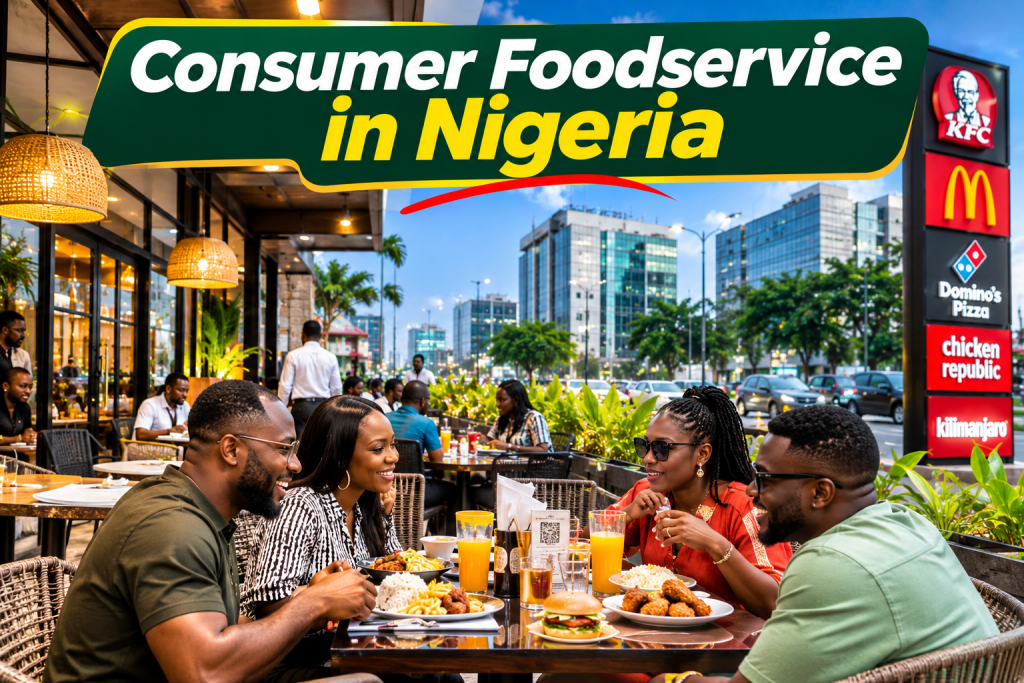
Nigeria’s consumer foodservice industry is changing as inflation, urbanisation, digital ordering and changing lifestyles reshape how people eat outside the home. From roadside food vendors and neighbourhood bukas to international quick-service restaurant chains and premium cafés, operators are competing for increasingly price-conscious customers. These changes are creating new opportunities for restaurant businesses, landlords, property investors and commercial real estate developers.
What Is Consumer Foodservice?
Consumer foodservice refers to the preparation and sale of food and beverages for immediate consumption outside the home. It includes restaurants, cafés, fast-food outlets, street food vendors, takeaway businesses, bars, food kiosks and delivery-led food businesses.
In Nigeria, the industry is particularly diverse. A customer may buy breakfast from a roadside akara seller, lunch from a neighbourhood buka, dinner from Chicken Republic or order pizza through a delivery platform.
The market therefore extends far beyond formal restaurants.
What Is the Market Size of Consumer Foodservice in Nigeria, How Big Is It?
Nigeria has one of Africa’s largest populations and a rapidly urbanising consumer base, making foodservice an important part of its consumer economy.
However, there is an important distinction between the size of the overall food economy and the size of consumer foodservice. Food production, grocery retail, packaged food sales and household food consumption should not automatically be counted as restaurant sales.
Euromonitor International’s latest data, reported by BusinessDay, puts the formal market at roughly $5.6 billion in 2025. Nigeria grew about 19% that year, behind only Turkey (32%) and Egypt (27%) globally.
A wider lens gives a bigger number. Mordor Intelligence sizes the broader foodservice market at $11.09 billion in 2025, rising to $21.38 billion by 2031 at an 11.55% CAGR (2026 to 2031). The gap exists because definitions differ: Euromonitor tracks formal consumer foodservice, while broader models capture more independent and informal trade.
Takeaway: growth is real, but part of the headline value is inflation. Transactions stayed below their 2021 to 2022 peak, so smart operators chase footfall and margin, not just naira sales.
What this means for investors: The market should be assessed through three separate measures:
- Market value: How much consumers spend on foodservice.
- Transaction volume: How many restaurant purchases take place.
- Outlet numbers: How many operating foodservice locations serve those customers.
These measures can move in different directions. Inflation can increase nominal sales value even when customers are buying fewer items or trading down to cheaper meals.
For a restaurant investor, rising market value does not automatically mean rising profitability.
Key Supply-Side and Demand Trends Shaping the Industry
1. Inflation and operating costs
High food prices, currency weakness, imported input costs, rent, electricity, fuel and logistics have increased pressure on restaurant operators.
Businesses must manage the cost of ingredients such as rice, chicken, cooking oil, flour, dairy products and imported food inputs. Energy-intensive businesses face additional pressure from generators, refrigeration and cold storage.
The USDA’s 2025 assessment identifies high food-price inflation, a weakened currency, elevated import costs and rising operating expenses as constraints on sector expansion.
2. Demand for affordable meals
Consumers are becoming more selective about where and how they spend money on food outside the home.
Affordable rice meals, local soups, grilled chicken, pastries, shawarma, noodles and budget-friendly fast food can appeal to customers seeking convenience without premium prices.
This supports demand for street stalls, kiosks, takeaway counters and limited-service restaurants.
3. Digital ordering and food delivery
Delivery platforms such as Glovo and Chowdeck are helping restaurants reach customers beyond their immediate physical locations.
Digital ordering can create additional sales opportunities, but commissions, packaging and delivery costs must be included in the restaurant’s financial model.
4. Expansion of organised restaurant chains
Established operators can use purchasing power, recognised brands, standardised menus and centralised operations to compete more effectively.
Leading force in the market includes Food Concepts Plc, operator of Chicken Republic, while Sundry Foods is particularly dynamic competitor.
5. Rising demand for convenient locations
Customers increasingly value food businesses near workplaces, residential communities, shopping centres, transport routes and educational institutions.
For landlords, this makes the right mix of accessibility, visibility, parking, power and delivery access important when positioning a commercial property for foodservice tenants.
Detailed Segmentation of International and Local Foodservice Products
Nigeria’s consumer foodservice market can be divided by cuisine, product type, service format and price positioning.
Local Nigerian foodservice products
| Segment | Popular products | Typical customer occasion |
|---|---|---|
| Rice-based meals | Jollof rice, fried rice, white rice and stew | Lunch and dinner |
| Traditional soups | Egusi, ogbono, efo riro, okra | Lunch and family meals |
| Swallow meals | Amala, eba, fufu, pounded yam | Lunch and dinner |
| Grilled foods | Suya, grilled fish, barbecue chicken | Evening and social occasions |
| Breakfast foods | Akara, moi moi, pap, bread and tea | Breakfast and takeaway |
| Local snacks | Puff-puff, buns, meat pie, chin chin | Snacks and convenience |
Local food has a major advantage: cultural familiarity. Operators can build strong customer loyalty by delivering consistent taste, generous portions, reliable hygiene and affordable pricing.
International and globally influenced foodservice products
| Segment | Popular products | Competitive positioning |
|---|---|---|
| American-style fast food | Burgers, fried chicken, fries | Convenience and brand recognition |
| Pizza | Pizza, wings, sides | Group meals and delivery |
| European-inspired | Pasta, sandwiches, pastries | Café and casual dining |
| Asian-inspired | Noodles, sushi, stir-fry | Variety and differentiated experience |
| Café products | Coffee, smoothies, cakes | Social and work-friendly spaces |
| Mexican-inspired | Wraps, tacos, burritos | Convenience and menu innovation |
International products do not necessarily need imported ingredients. Nigerian operators can localise recipes, source ingredients locally and adjust portion sizes and prices to match local purchasing power.
Which product segments offer the greatest opportunity?
The strongest commercial opportunities are likely to be in affordable local meals, chicken-based quick-service formats, bakery and snack concepts, value-priced burgers, convenient breakfast products and delivery-friendly menus.
The most attractive concept is not necessarily the most fashionable one. It is the one that matches customer demand, maintains healthy margins and can operate efficiently from its chosen location.
Historic Market Performance: 2020–2025
The industry experienced several important changes during this period.
| Period | Major market development |
|---|---|
| 2020 | COVID-19 restrictions disrupted dine-in restaurants and encouraged takeaway and delivery |
| 2021 | Reopening supported recovery in restaurant visits and transactions |
| 2022 | Inflation and rising operating expenses increased pressure on operators |
| 2023 | Currency depreciation and higher food prices affected menu pricing and consumer spending |
| 2024 | Operators increasingly focused on affordability, alternative proteins and delivery |
| 2025 | Consumers continued shifting towards value-led meals, kiosks and limited-service restaurants |
What about historic market value and volume?
It is important not to confuse revenue growth with real market expansion.
For example, if a restaurant increases its average meal price from ₦5,000 to ₦7,000, its revenue per transaction increases by 40%, even if the number of customers remains unchanged.
Leading Brands in Consumer Foodservice in Nigeria
Nigeria’s competitive landscape includes established local operators, international restaurant chains, independent businesses and emerging digital-first food brands.
Major local operators
1. Chicken Republic by Food Concepts Plc
Chicken Republic is one of Nigeria’s most recognisable quick-service restaurant brands. Its chicken-based meals, broad outlet network and value positioning have helped it maintain a strong competitive position.
2. Kilimanjaro by Sundry Foods
Kilimanjaro offers Nigerian meals and quick-service dining. Sundry Foods is one of the market’s most dynamic operators, supported by outlet expansion and delivery capabilities.
3. PieXpress by Food Concepts Plc
PieXpress uses smaller, lower-cost formats to reach customers seeking convenient snacks and affordable food. It is particularly relevant to the street stalls and kiosk segment.
4. The Chop Box by Food Concepts Plc
This is another brand within the Food Concepts portfolio, reflecting the company’s strategy of developing different foodservice concepts for different customer occasions.
Major international and multinational brands
Examples include:
- KFC: fried chicken and quick-service meals.
- Domino’s Pizza: pizza, takeaway and delivery.
- Burger King: burgers and drive-through-oriented formats.
- Cold Stone Creamery: premium ice cream and dessert experiences.
These brands compete through brand recognition, standardised products, operational systems, customer experience and digital ordering.
How do company and brand market shares compare?
- Food Concepts Plc, through Chicken Republic, leads limited-service restaurants by foodservice value.
- Sundry Foods is identified as the most dynamic company in limited-service restaurants.
- Independent operators hold the largest share of limited-service foodservice value.
- Chicken Republic remains a key operator in standalone locations.
How Are Multinational and Local Operators Competing and Expanding?
The competition is increasingly about more than food quality.
| Competitive factor | Multinational operators | Local operators |
|---|---|---|
| Brand recognition | Established international identities | Strong local familiarity |
| Menu strategy | Global products adapted locally | Local tastes and recipes |
| Procurement | Structured supply systems | Local sourcing and supplier relationships |
| Pricing | Brand-led positioning and promotions | Flexible pricing and portion sizes |
| Expansion | Franchising and standardised outlets | Smaller outlets and local market knowledge |
| Digital channels | Integrated ordering and loyalty | Delivery partnerships and social media |
International and local operators are also exploring smaller formats, drive-through locations, delivery integration and menu adjustments to accommodate affordability.
How Are Lifestyle Trends and Eating Habits Shaping Demand?
Nigeria’s foodservice market is influenced by the way people live, work, travel and socialise.
Convenience and time pressure
Office workers, students, commuters and busy households increasingly value food that is accessible and quick to purchase.
This supports breakfast outlets, takeaway counters, quick-service restaurants, food kiosks and delivery businesses.
Youthful consumers and social dining
Younger consumers are important customers for cafés, fast-food restaurants, dessert outlets, casual dining and social food experiences.
Digital-first consumption
Consumers increasingly discover restaurants through Instagram, TikTok, Google, WhatsApp and food delivery platforms. Online visibility, customer reviews, attractive menus and reliable fulfilment are becoming important competitive assets.
Social and group dining
Restaurants are also places for birthdays, business meetings, family outings and social gatherings. This creates opportunities for casual dining, cafés, lounges and restaurants with private dining areas.
How Significant Are Health Considerations?
Health is likely to become an increasingly important differentiator, although affordability remains a major purchasing consideration.
Consumers are showing interest in:
- Freshly prepared meals.
- Reduced sugar and healthier beverages.
- Grilled rather than deep-fried options.
- Fresh vegetables and salads.
- Better portion control.
- Food safety and hygiene.
- Alternative protein options.
For operators, the opportunity is to make healthier eating accessible rather than positioning it exclusively as a premium product.
A restaurant could introduce grilled chicken, vegetable-rich rice bowls, fresh fruit drinks and smaller meal portions without abandoning its core menu.
The greatest potential demand is likely to come from affordable, convenient meals that combine familiar Nigerian flavours with better nutritional choices.
This approach can appeal to office workers, young professionals, fitness-conscious consumers and families.
Five-Year Forecast: What Will Consumer Foodservice Look Like by 2030?
Indicative five-year outlook
| Market trend | 2026–2030 outlook | Likely beneficiaries |
|---|---|---|
| Affordable quick-service meals | Strong opportunity | QSRs, kiosks, takeaway outlets |
| Local Nigerian cuisine | Strong opportunity | Bukas, casual dining, local chains |
| Food delivery | Growing opportunity | Digital-first restaurants, cloud kitchens |
| Premium dining | Selective growth | Established premium operators |
| Cafés and social dining | Positive opportunity | Cafés, dessert shops, lifestyle centres |
| Health-focused menus | Emerging opportunity | Healthy meal brands, juice and salad bars |
| Renewable energy and efficient kitchens | Increasing importance | Operators with high energy consumption |
A numerical market-growth scenario
Mordor Intelligence places Nigeria’s broader foodservice market at approximately US$11.09 billion in 2025, rising to US$12.37 billion in 2026 and US$21.38 billion by 2031. It projects an 11.55% CAGR for 2026–2031.
Where Will Future Growth Be Most Dynamic?
The strongest opportunities are likely to emerge where population density, commercial activity, convenience and purchasing power intersect.
Lagos
Victoria Island and Ikoyi: Premium dining, business lunches, cafés, hotel foodservice and corporate hospitality.
Lekki Phase 1 and the Lekki-Epe corridor: Quick-service restaurants, family dining, takeaway, delivery-led concepts and cafés serving growing residential communities.
Ikeja GRA and Allen Avenue: Corporate lunch, casual dining, fast food and convenient takeaway.
Yaba and Surulere: Student-oriented foodservice, affordable local meals, snacks, cafés and delivery-focused businesses.
Ajah and Sangotedo: Neighbourhood restaurants, family food outlets, bakeries and value-led quick-service concepts.
Other Nigerian cities
Abuja, Port Harcourt, Ibadan, Kano, Enugu, Benin City and Kaduna offer opportunities linked to urban growth, commercial activity, education, transport and residential expansion.
Nigeria’s urban population was estimated at approximately 151.5 million in 2025, representing around 64% of the total population in the World Bank’s urban population dataset. This provides an important structural demand backdrop, although urbanisation alone does not guarantee restaurant profitability.
Commercial Real Estate: What Does This Mean for Restaurant Landlords, Tenants and Investors?
Consumer foodservice growth creates demand for a wide range of commercial property formats.
The next successful restaurant location may not always be a large shopping mall unit. It could be a compact takeaway outlet beside an office cluster, a kiosk in a residential estate, a drive-through on a major road or a delivery-oriented kitchen in a strategically positioned neighbourhood.
For landlords and developers, Food tenants pay for footfall, frontage, power and parking. Units in Lekki Phase 1, Victoria Island, Ikoyi, Ikeja GRA and Apapa that offer reliable utilities and delivery access will lease fastest. Important property features include:
- Adequate electrical capacity and reliable power options.
- Water supply, drainage and waste disposal.
- Kitchen ventilation and exhaust routes.
- Customer parking and pedestrian access.
- Delivery rider access and collection points.
- Storage and refrigeration space.
- Suitable zoning and permission for foodservice use.
- Visibility from major roads and commercial activity.
For tenants, the most important calculation is total occupancy cost relative to realistic sales potential. Rent, service charges, power, maintenance and logistics must all fit the restaurant’s expected margins.Negotiate on location quality over square metres. A smaller, well-sited unit with delivery access often beats a large dine-in space.
For startups and SMEs
Start lean: a kiosk, cloud kitchen or shared kitchen lets you test demand before taking a full lease.
For investors
Look for operators with disciplined unit economics, delivery integration and local-menu strength. Fragmentation signals room to consolidate.
Ready to Secure a Food-Ready Space in Lagos?
Whether you are leasing a kiosk, a restaurant unit or a retail frontage, location decides outcomes. Speak with UPG Real Estate Commercial Advisors, for retail space across Lagos.
UPG REALESTATE COMMERCIAL ADVISORS (+234-80-8460-1193) can support restaurant operators, landlords and investors with commercial location sourcing, restaurant site selection, leasing, landlord advisory and commercial property strategy.
7 Foodservice Trends Investors and Operators Should Watch
- Affordable Nigerian meals: Familiar local dishes can attract repeat customers when pricing and portion sizes match purchasing power.
- Chicken-based quick service: Chicken, burgers, rice meals and value combinations remain attractive formats for organised operators.
- Delivery integration: Restaurants that manage digital ordering, packaging, delivery costs and customer retention effectively can reach customers beyond their immediate neighbourhood.
- Smaller restaurant formats: Kiosks, compact outlets and takeaway counters can reduce initial property and fit-out commitments.
- Healthier everyday menus: Affordable grilled meals, vegetables, fresh beverages and portion options offer room for product differentiation.
- Energy-efficient operations: Solar, battery storage, efficient refrigeration and kitchen equipment can help reduce exposure to unreliable power and high operating costs.
- Strategic commercial locations: Residential growth, office clusters, transport corridors, universities and retail destinations can create attractive customer catchments.
In Conclusion: Is Consumer Foodservice in Nigeria a Good Investment Opportunity?
Nigeria’s consumer foodservice industry has significant long-term potential, supported by population growth, urbanisation, convenience-led lifestyles and the development of organised restaurant brands.
However, the market is not without challenges. Inflation, weak purchasing power, expensive energy, currency pressure and high operating costs mean that growth in sales value does not necessarily translate into higher profits.
The most promising opportunities are likely to come from businesses that combine affordable products, efficient operations, digital ordering, strong customer retention and carefully selected locations.
For commercial property investors and landlords, foodservice is an important tenant category worth understanding. For restaurant entrepreneurs, the winning formula is not simply opening in a busy area. It is finding a location where the right customers can afford the menu, access the restaurant conveniently and return regularly.
Frequently Asked Questions
1. What is the market size of consumer foodservice in Nigeria?
Mordor Intelligence estimate places the broader Nigerian foodservice market at US$11.09 billion in 2025.
2. Which are the leading consumer foodservice brands in Nigeria?
Important brands include Chicken Republic, Kilimanjaro, PieXpress, KFC, Domino’s Pizza, Burger King and Cold Stone Creamery. Chicken Republic, operated by Food Concepts Plc, has a particularly strong position in limited-service restaurants. Kilimanjaro, operated by Sundry Foods, is another important local competitor. Independent restaurants and street food businesses also account for a substantial part of the market.
3. What are the fastest-growing opportunities in Nigeria’s restaurant industry?
Affordable quick-service meals, local Nigerian cuisine, chicken-based meals, takeaway outlets, food kiosks, delivery-friendly restaurants and convenient neighbourhood foodservice are attractive opportunities. Healthier everyday meals and energy-efficient kitchen operations also offer potential. Actual performance will depend on location, customer spending, pricing and operational efficiency.
4. How are delivery platforms changing consumer foodservice in Nigeria?
Platforms such as Glovo and Chowdeck help restaurants reach customers who prefer ordering from home, offices and other locations. They also provide digital visibility and ordering infrastructure. However, operators must account for platform commissions, packaging, delivery reliability, promotions and customer acquisition costs. A restaurant should measure the profitability of delivery orders separately from dine-in transactions.
5. Which Nigerian locations offer the greatest opportunities for restaurant investment?
In Lagos, Victoria Island, Ikoyi, Lekki Phase 1, Ikeja GRA, Yaba, Surulere, Ajah and Sangotedo offer opportunities for different foodservice formats. Abuja, Port Harcourt, Ibadan, Kano and Enugu are also important markets. The best location depends on the concept: premium restaurants need suitable spending power, while affordable takeaway businesses need strong daily customer traffic and convenient access.