
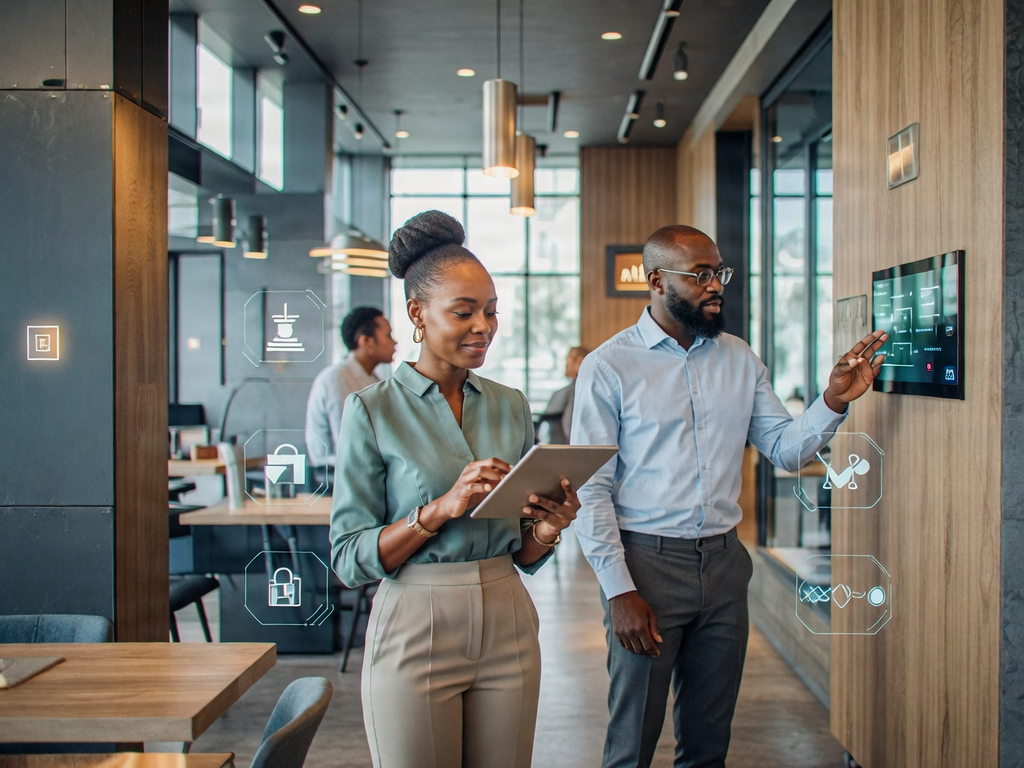
What Is a Smart Restaurant Building?
Smart building technology is transforming how modern restaurants manage electricity, security, refrigeration, customer comfort, maintenance, and daily operations. For restaurant owners in Lagos and across Nigeria, the right building features can improve operational efficiency, reduce avoidable costs, protect food quality, and support business expansion. From intelligent energy monitoring and automated lighting to smart security, connected kitchen equipment, and renewable energy systems, choosing a technology-ready commercial property can give a restaurant a lasting competitive advantage.
Smart Building Features Every Modern Restaurant Should Have
A smart restaurant building uses connected devices, sensors, automation, and monitoring systems to improve how the property operates.
These systems can help restaurant managers monitor building conditions, identify equipment problems, manage energy consumption, improve security, and maintain comfortable customer areas.
A smart restaurant building may include:
- Smart electricity meters
- Automated lighting
- Intelligent air-conditioning controls
- Refrigeration temperature monitoring
- Water-leak detection
- Smart security systems
- Digital access control
- Internet-connected equipment
- Energy management systems
- Predictive maintenance tools
- Solar and battery monitoring
- Smart fire and safety systems
Not every restaurant needs every feature. The right combination depends on the restaurant’s size, operating model, budget, equipment, and long-term plans.
1. Smart Energy Monitoring Systems
Electricity is a major operating consideration for many restaurants, particularly those that depend on refrigeration, cooking equipment, air conditioning, ventilation, and backup power.
A smart energy monitoring system helps management understand how electricity is being consumed.
Depending on the system, it may track:
- Total electricity consumption
- Consumption by individual circuits
- Peak demand
- Equipment operating patterns
- Unusual energy usage
- Energy consumption during closed hours
- Performance of solar and battery systems
For example, if a restaurant’s electricity consumption rises unexpectedly, management can investigate whether the cause is a refrigeration fault, an inefficient air conditioner, additional operating hours, or equipment being left on unnecessarily.
Commercial property consideration: Before leasing a restaurant, check whether the electrical infrastructure supports appropriate metering, monitoring, and future upgrades.
2. Automated Lighting Systems
Smart lighting helps restaurants control when and how lighting operates.
Useful features include:
- Motion sensors
- Occupancy sensors
- Timers
- Programmable schedules
- Dimmable lighting
- Daylight-responsive controls
- Remote switching
For example, external security lighting can follow a programmed schedule, while storage-room lights can switch off automatically when the space is unoccupied.
Dining-room lighting can also be adjusted to support different service periods, such as breakfast, lunch, and dinner.
Smart lighting should complement the restaurant’s design and customer experience rather than make the space feel overly automated.
3. Smart Air-Conditioning and Climate Control
Customer comfort is important for restaurants, particularly in Lagos’s warm climate.
Smart HVAC controls can help regulate temperature and operating schedules.
Potential features include:
- Programmable thermostats
- Zoned cooling
- Remote temperature control
- Equipment performance monitoring
- Operating schedules
- Alerts for abnormal conditions
A restaurant can maintain different temperature settings for customer areas, offices, and selected back-of-house spaces according to their needs.
Kitchen ventilation must be designed separately to manage heat, smoke, grease, and cooking fumes safely.
Smart controls should not compromise required ventilation, food safety, or indoor air quality.
4. Smart Refrigeration Monitoring
Refrigeration is essential for food safety and inventory protection.
A refrigeration failure can result in food spoilage, financial losses, and service disruption.
Smart refrigeration systems can provide:
- Continuous temperature monitoring
- High-temperature alerts
- Door-open notifications
- Equipment fault alerts
- Remote monitoring
- Maintenance reminders
- Historical temperature records
For restaurants with several refrigerators, freezers, or cold rooms, centralized monitoring can make it easier to identify problems quickly.
For example, a manager could receive an alert if a cold room moves outside its approved operating temperature range.
The system should be supported by documented food-safety procedures, regular inspections, and appropriate backup arrangements.
5. Smart Security Cameras
Security is an important consideration for restaurants, which may handle cash, valuable equipment, inventory, and customer property.
A modern security system can include:
- Network-connected cameras
- Remote viewing
- Motion alerts
- Video recording
- Secure footage storage
- Entry-point monitoring
- Equipment-room monitoring
Camera placement should focus on appropriate areas, such as entrances, exits, delivery points, cash-handling areas, and stockrooms.
Restaurants should respect employee and customer privacy, avoid inappropriate surveillance in private spaces, and follow applicable data-protection requirements.
6. Digital Access Control
Digital access control can help restaurant managers regulate who enters restricted areas.
Potential features include:
- Electronic door locks
- Access cards
- PIN-based entry
- Authorized mobile credentials
- Time-based access permissions
- Entry logs
For example, access to a stockroom, office, electrical room, or equipment area can be restricted to authorized personnel.
Access permissions should be updated when employees leave or change responsibilities.
Emergency exits and fire-safety requirements must remain fully compliant.
7. Smart Fire and Safety Systems
Fire and safety systems are essential in commercial kitchens and restaurant buildings.
Depending on the property and applicable requirements, systems may include:
- Smoke detection
- Heat detection
- Fire alarms
- Emergency lighting
- Equipment fault monitoring
- Water-leak alerts
- Appropriate kitchen fire-suppression systems
Commercial kitchens can involve open flames, hot surfaces, electrical equipment, oils, and grease.
Smart monitoring may help identify certain hazards earlier, but it cannot replace appropriate fire protection, inspections, staff training, or emergency procedures.
Before leasing a property, verify that the existing systems are suitable for the intended restaurant use.
8. Water-Leak Detection
Water leaks can damage floors, ceilings, walls, equipment, electrical installations, and stored inventory.
A smart leak-detection system can alert management when it detects water in vulnerable areas.
Useful monitoring points may include:
- Under sinks
- Near water heaters
- Around pumps
- Near dishwashing equipment
- In plant rooms
- Around refrigeration drainage
- In storage areas with plumbing connections
Early detection can reduce the time between a leak developing and maintenance staff responding.
The property should also have accessible shut-off valves and a clear emergency response procedure.
9. Smart Water Management
Restaurants use water for cooking, washing, sanitation, cleaning, and customer facilities.
Smart water meters and monitoring systems can help track consumption and identify unusual usage.
Features may include:
- Digital water meters
- Consumption alerts
- Leak detection
- Pump monitoring
- Tank-level monitoring
- Automated pump controls
For properties that rely on water storage tanks, monitoring tank levels can help managers identify supply problems before operations are disrupted.
These systems are particularly useful where water supply is inconsistent or water infrastructure requires close supervision.
10. Smart Generator and Backup Power Monitoring
In Nigeria, many commercial properties combine grid electricity with generators, inverters, batteries, or solar power.
Smart monitoring can help restaurant managers understand the performance of these systems.
Depending on the equipment, monitoring may cover:
- Generator operating hours
- Fuel levels
- Battery state of charge
- Inverter performance
- Solar production
- Electrical load
- Fault alerts
- Maintenance schedules
This can help management plan maintenance and investigate unusual operating costs.
For example, monitoring may reveal that a generator is running longer than expected or that a battery system is not performing as designed.
Electrical integration should be handled by qualified professionals, and critical equipment should have suitable backup arrangements.
11. Solar and Battery Monitoring
Restaurants investing in renewable energy should consider systems that provide visibility into solar and battery performance.
Useful information can include:
- Solar electricity generation
- Energy supplied to the building
- Battery charge levels
- Battery discharge
- Grid electricity consumption
- System faults
- Historical performance
This information helps managers determine whether the energy system is operating as intended.
When selecting a commercial property, check whether the building can accommodate the necessary solar equipment, batteries, inverters, electrical connections, and maintenance access.
Tenants should obtain the appropriate permissions before installing equipment on a leased property.
12. Smart Internet and Network Infrastructure
Reliable internet connectivity supports many restaurant technologies.
A modern restaurant may depend on connectivity for:
- Point-of-sale systems
- Digital payments
- Online ordering
- Delivery platforms
- Inventory software
- Cloud accounting
- Security cameras
- Smart equipment
- Customer Wi-Fi
Before leasing a property, confirm that internet service is available and that installation is practical.
For restaurants where connectivity is essential, consider backup connectivity and appropriate network security.
Business-critical systems should have a contingency plan for internet outages.
13. Smart Point-of-Sale Integration
Although a point-of-sale system is not itself a building feature, it is a key part of a technology-enabled restaurant.
A modern POS system can connect sales activity with inventory, kitchen operations, payments, and reporting.
Depending on the software, features may include:
- Digital order management
- Menu management
- Sales reporting
- Inventory tracking
- Staff permissions
- Payment integration
- Multi-branch reporting
Restaurant owners should ensure that the building’s internet and electrical infrastructure can support these systems reliably.
14. Smart Kitchen Equipment
Connected kitchen equipment can improve visibility into equipment performance and operating conditions.
Depending on the manufacturer, equipment may provide:
- Operating-status alerts
- Temperature monitoring
- Programmable settings
- Maintenance notifications
- Remote diagnostics
- Usage records
These features can be useful for restaurants with complex kitchen operations or several branches.
However, restaurant owners should evaluate compatibility, reliability, support, and total ownership costs before investing in connected equipment.
15. Predictive Maintenance Systems
Traditional maintenance often relies on fixed schedules or waiting for equipment to fail.
Smart maintenance systems can combine equipment data, operating hours, fault alerts, and service records to help identify maintenance needs earlier.
This can apply to:
- Air-conditioning systems
- Refrigeration
- Pumps
- Generators
- Kitchen extraction
- Solar equipment
- Water systems
- Electrical infrastructure
For a restaurant group with multiple locations, centralized maintenance records can help management identify recurring problems and coordinate contractors.
Predictive maintenance is most useful when the available data is reliable and the business has a process for responding to alerts.
16. Smart Parking and Access Management
Parking can affect the customer experience, particularly for restaurants that depend on dine-in customers.
Depending on the property, technology can support:
- Parking access control
- Digital visitor registration
- Security monitoring
- Entry and exit records
- Space availability monitoring
For a restaurant in a busy commercial area, effective parking and access arrangements can help reduce congestion.
However, parking technology cannot compensate for insufficient physical parking capacity or poor road access.
17. Digital Building Management Systems
Larger restaurants, hotels, food halls, and multi-tenant commercial buildings may benefit from a building-management system.
Such systems can bring selected building functions into one monitoring platform.
Depending on the installation, this may include:
- HVAC
- Lighting
- Energy meters
- Water systems
- Equipment alarms
- Environmental sensors
- Solar and battery monitoring
A building-management system can help facility managers identify problems and coordinate maintenance.
For a small restaurant, individual smart devices may be more economical than a comprehensive integrated system.
The appropriate solution depends on the building’s complexity and the expected return on investment.
18. Smart Building Features for Different Restaurant Types
Fine-Dining Restaurants
Prioritize climate control, lighting automation, security, internet reliability, refrigeration monitoring, and discreet technology that preserves the dining atmosphere.
Quick-Service Restaurants
Focus on energy monitoring, POS connectivity, kitchen equipment, digital order management, refrigeration alerts, and efficient pickup operations.
Cafés
Consider smart lighting, temperature controls, security, internet infrastructure, and efficient monitoring of coffee and refrigeration equipment.
Bakeries
Prioritize temperature monitoring, production equipment, energy management, ventilation, and maintenance alerts.
Delivery Kitchens
Focus on refrigeration, power monitoring, network reliability, security, inventory integration, and dispatch efficiency.
Supermarkets and Food Retailers
Give particular attention to cold-chain monitoring, HVAC, energy management, security, water systems, and backup power.
19. How to Choose a Smart-Ready Restaurant Property
Smart building technology should be considered before signing the lease.
Use this checklist during property inspections.
Electrical infrastructure
- Is the electrical capacity adequate?
- Are distribution boards and wiring suitable?
- Can monitoring equipment be installed?
Connectivity
- Is reliable internet available?
- Can network equipment be installed securely?
- Is backup connectivity practical?
Energy
- Can energy meters be installed?
- Is solar installation feasible?
- Can generator and battery performance be monitored?
Kitchen
- Can refrigeration sensors be installed?
- Is there adequate ventilation?
- Can kitchen equipment connect to the required systems?
Security
- Are there suitable locations for cameras?
- Can access controls be installed?
- Are doors and entry points suitable?
Water and safety
- Can water-leak sensors be installed?
- Are fire-safety systems appropriate?
- Are equipment and maintenance areas accessible?
Lease
- Does the landlord permit the required installations?
- Who owns the installed equipment?
- Who maintains the systems?
- What happens to installations when the lease ends?
20. Calculate the Return on Investment
Smart technology should solve a real problem or deliver a measurable benefit.
Before purchasing a system, estimate its total cost and expected savings.
A basic calculation is:
Annual Net Benefit = Annual Cost Savings + Other Measurable Benefits − Annual Operating Costs
Payback Period = Initial Investment ÷ Annual Net Benefit
For example, a monitoring system may be worthwhile if it reduces equipment downtime, prevents spoilage, or lowers unnecessary energy consumption enough to justify its purchase and maintenance costs.
The actual savings should be measured rather than assumed.
Some systems mainly provide operational control and risk reduction rather than immediate cash savings.
7 Smart Building Features Every Modern Restaurant Should Prioritize
- Smart energy monitoring: Track consumption and identify avoidable energy waste.
- Refrigeration temperature alerts: Protect food inventory and improve response to equipment faults.
- Automated lighting and HVAC: Improve control over lighting and cooling schedules.
- Security and access control: Monitor entrances and restrict access to sensitive areas.
- Water-leak detection: Identify leaks before they cause extensive damage.
- Backup power monitoring: Improve visibility into generator, inverter, battery, and solar performance.
- Reliable network infrastructure: Support payments, ordering, inventory, security, and connected equipment.
These features provide a practical starting point for restaurants that want to modernize their buildings without investing in unnecessary complexity.
The Role of Commercial Real Estate in Smart Restaurant Operations
A smart restaurant needs more than software and connected devices. It needs a property that can support the technology.
An unsuitable building may have limited electrical capacity, poor internet connectivity, inadequate equipment space, insufficient ventilation, or restrictive lease conditions.
These limitations can increase installation costs and delay opening.
A commercial real estate advisor can help restaurant operators assess:
- Property suitability
- Infrastructure readiness
- Total occupancy costs
- Installation requirements
- Lease permissions
- Energy opportunities
- Expansion potential
- Long-term operating risks
For restaurant groups, a consistent property assessment process can also make it easier to compare locations before expanding.
Conclusion
Smart building features can help modern restaurants improve energy management, protect inventory, strengthen security, monitor equipment, and maintain a more reliable operating environment.
The best approach is to identify the restaurant’s most important operational risks, select technology that addresses those risks, and choose a commercial property that can support the required systems.
For restaurants in Lagos and across Nigeria, smart energy monitoring, refrigeration alerts, reliable internet, backup power monitoring, automated controls, and effective security can be practical starting points.
A smart restaurant building does not need to be the most technologically advanced property available. It needs to be reliable, efficient, secure, easy to maintain, and suitable for the restaurant’s business model.
Frequently Asked Questions
1. What is the most important smart building feature for a restaurant?
There is no single best feature for every restaurant. Refrigeration monitoring, energy management, security, and reliable internet are often useful starting points. The right priorities depend on the restaurant’s size, equipment, operating model, and biggest risks.
2. Are smart building systems expensive for small restaurants?
Costs vary widely. Small restaurants can begin with selected devices, such as smart meters, temperature sensors, lighting controls, or water-leak detectors. More complex building-management systems may be appropriate for larger properties or restaurant groups.
3. Can smart technology reduce restaurant operating costs?
It can help reduce avoidable energy use, identify equipment problems, improve maintenance planning, and prevent certain losses. However, savings depend on the system, how it is used, the condition of existing equipment, and the restaurant’s operating practices.
4. What should I check before leasing a smart-ready restaurant property?
Check electrical capacity, internet availability, equipment space, ventilation, refrigeration infrastructure, security, water systems, backup power, and permission to install technology. Clarify maintenance responsibilities and equipment ownership in the lease.
5. Should every restaurant install a building-management system?
No. A full building-management system may be unnecessary for a small restaurant. Individual monitoring devices or simpler automation may deliver better value. Larger restaurants, food halls, hotels, and multi-branch operators may benefit more from integrated systems.